
B2B Regulatory Compliance: Turning EU Regulations into a Competitive Advantage
Breaking into Europe is often seen as a compliance-heavy challenge, but for forward-thinking companies, it presents a strategic opportunity. Strict frameworks like GDPR and emerging policies such as the AI Act are not just barriers, but signals of market maturity and trust, especially as the AI Act complements GDPR in regulating AI systems and personal data across the EU.
For scaling companies, B2B regulatory compliance is no longer a backend function. It is a growth lever that directly impacts customer trust, deal velocity, and long-term positioning. The real question is not how to manage compliance, but how to use it to accelerate EU market compliance and gain a competitive edge.
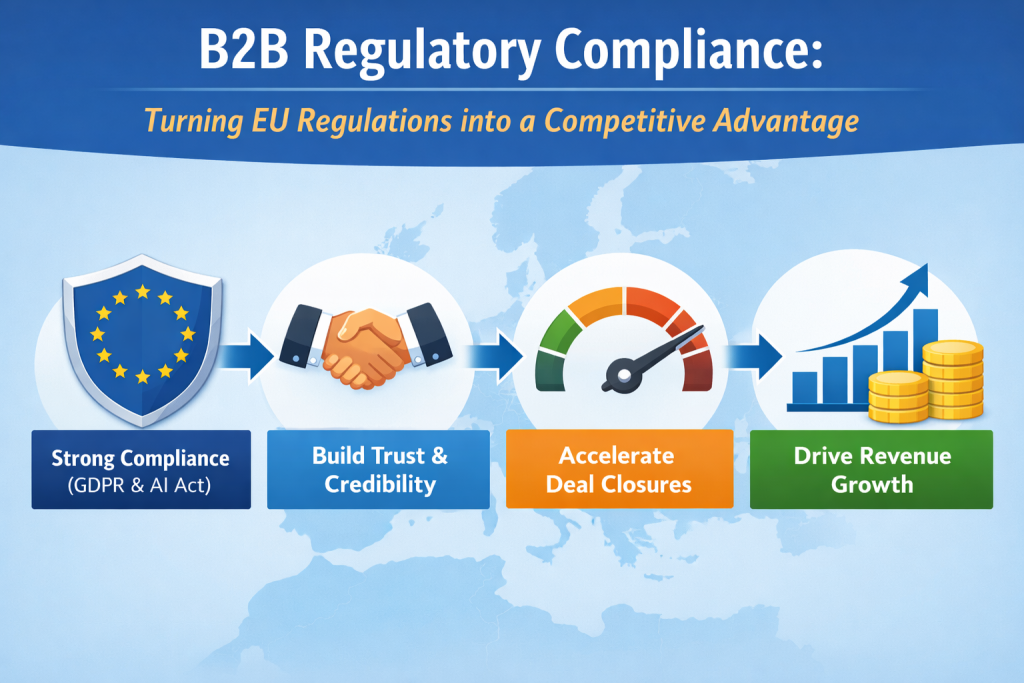
Why is B2B regulatory compliance a growth driver, not a barrier?
Most companies delay compliance until it becomes unavoidable. Entering Europe without a clear compliance strategy often leads to delays and lost opportunities. A strong B2B regulatory compliance framework ensures that expansion efforts align with local expectations from the start.
European buyers prioritize transparency and accountability. This makes EU market compliance a key factor in decision-making, especially during early-stage European market expansion. Companies that integrate compliance into their market entry plan will easily reduce friction in sales and build trust faster.
Rather than treating compliance as a backend task, businesses that adopt compliance as a competitive advantage position themselves more effectively in regulated markets.
How EU Market Compliance Builds Trust with Enterprise Buyers
A successful European market expansion depends on embedding B2B regulatory compliance directly into a structured market entry plan. Instead of approaching compliance as a final checkpoint, companies must integrate it from the earliest stages to ensure a smooth and risk-aware expansion process.
The foundation of this approach lies in early alignment with EU market compliance requirements, including GDPR and AI Act readiness. Addressing these regulatory expectations during the initial market validation phase helps identify risks early, avoid costly delays, and create a more predictable expansion journey.
As the plan progresses, B2B regulatory compliance should be embedded into product design, data handling practices, and go-to-market strategies. This ensures that compliance is consistently reflected across all customer touchpoints while also aligning internal teams such as sales, legal, and product. Such alignment not only improves execution efficiency but also strengthens trust with European buyers.
In parallel, companies must remain adaptable to evolving tech expansion regulations. Building internal processes to monitor regulatory changes and respond quickly ensures long-term stability across multiple European markets. This proactive approach helps maintain consistency while reducing the risk of disruption.
By integrating B2B regulatory compliance into a market entry plan, businesses can scale confidently while ensuring their European market expansion remains structured, compliant, and sustainable.
The role of EU market compliance in building trust and accelerating expansion
Trust plays a central role in European market expansion, and EU market compliance is one of its strongest signals. For scaling tech companies, demonstrating strong B2B regulatory compliance significantly enhances credibility with enterprise buyers.
Compliance readiness also directly impacts sales velocity. When companies clearly meet European tech expansion regulations, buyers require less due diligence, which shortens procurement cycles and reduces friction in decision-making.
With a market entry plan, this trust advantage translates into faster deal closures, stronger early traction, and improved positioning. In this way, compliance becomes not just a requirement but a strategic lever for accelerating growth in European markets.
How does B2B regulatory compliance drive revenue growth?
When used strategically, B2B regulatory compliance does more than reduce risk but it drives measurable business outcomes. For scaling tech companies, strong compliance frameworks improve conversion rates and unlock access to high-value clients.
Companies that integrate B2B regulatory compliance into their go-to-market strategy often experience:
- Higher win rates in regulated industries
- Faster enterprise deal closures
- Stronger partner and channel relationships
In a structured market entry plan, compliance enables premium positioning. Businesses can justify higher pricing by offering security, transparency, and reduced risk, reinforcing compliance as a competitive advantage.
| Compliance Capability | Business Impact | Expansion Outcome |
| GDPR & AI Act alignment | Builds trust | Faster deal closures |
| Data transparency | Reduces buyer friction | Higher conversion rates |
| Security & documentation | Speeds due diligence | Shorter sales cycles |
| Regulatory readiness | Enables premium positioning | Higher pricing power |
Key tech expansion regulations shaping EU market compliance
Understanding tech expansion regulations is essential for effective B2B regulatory compliance. These regulations influence how companies design products, manage data, and operate in Europe.
Frameworks like GDPR and emerging AI regulations define the foundation of EU market compliance. For scaling tech companies, aligning with these standards early with a market entry plan ensures smoother execution.
Rather than adapting late, companies that proactively address European market expansion requirements build stronger operational resilience and avoid disruptions.
EU market compliance checklist for a successful market entry plan
A strong B2B regulatory compliance foundation is essential before executing a market entry plan. For scaling tech companies, this checklist ensures alignment with EU market compliance and reduces risks during European market expansion.
Key areas to focus on include:
- Ensure GDPR and AI Act alignment, covering data usage, risk classification, and transparency requirements under key tech expansion regulations
- Validate legal entity structure, taxation, and contracts to support smooth EU market compliance
- Implement privacy-by-design and AI governance principles within product architecture to strengthen B2B regulatory compliance
- Align sales, legal, and product teams to avoid delays during the market entry plan
- Prepare documentation for security, data handling, and compliance audits to build trust in European market expansion
- Continuously monitor evolving tech expansion regulations, including updates to the AI Act, to maintain long-term compliance readiness
This checklist helps scaling tech companies treat B2B regulatory compliance not just as a requirement, but as a strategic enabler of successful European market expansion.
Common challenges in B2B regulatory compliance for scaling tech companies
Despite its clear advantages, B2B regulatory compliance is rarely straightforward. For many scaling tech companies, the complexity lies not just in understanding regulations but in executing them effectively during European market expansion.
The challenges that companies face are:
- Underestimating EU compliance requirements: Many companies assume basic readiness is enough, but European standards often demand deeper legal, data, and operational alignment.
- Delayed compliance integration: Treating compliance as a late-stage activity leads to rushed implementation, increasing risk and slowing down go-to-market efforts.
- Fragmented internal execution: Lack of coordination between product, legal, and sales teams creates inconsistencies and gaps in compliance readiness.
- Evolving and complex regulations: Constantly changing tech expansion regulations make it difficult to stay updated without a dedicated compliance strategy.
- Resource and expertise gaps: Limited access to local regulatory knowledge can hinder smooth execution and decision-making.
Addressing these challenges early, especially within a structured market entry plan ensures that compliance becomes an enabler of growth rather than a bottleneck.
Conclusion
B2B regulatory compliance is a strategic advantage that can accelerate European market expansion. For scaling tech companies, the ability to align early with EU market compliance frameworks such as GDPR and the EU AI Act, along with evolving tech expansion regulations, directly impacts trust, deal velocity, and long-term growth.
By embedding compliance into a structured market entry plan, businesses can move beyond reactive approaches and build a foundation for sustainable scaling. From strengthening credibility with enterprise buyers to unlocking premium positioning, compliance becomes a driver of both efficiency and revenue.
Companies that treat B2B regulatory compliance as a core growth lever and not a constraint, are the ones that succeed in competitive European markets. In a landscape defined by regulation and trust, compliance is not the barrier to expansion. Begin building your ideal AI-driven development roadmap by exploring our B2B regulatory compliance market expansion strategy services.