
EU AI Act: What the August 2, 2026 Deadline Actually Requires (and How to Get Ready)
On August 2, 2026 the EU AI Act’s transparency rules become enforceable and the European AI Office gains full power to fine general-purpose AI providers. The headline high-risk obligations that many teams feared this date have been pushed to December 2027 by the newly adopted Digital Omnibus, so the real task now is narrower, clearer, and still time-bound: get your chatbot, synthetic-content, and GPAI disclosures right.
That reset matters because it changes what you should be doing in the next few weeks. Below is a practical, decision-maker’s view of what actually comes due on August 2, 2026, what moved, what the penalties are, and how software and AI-using companies (including those outside the EU) should prepare.
What changes on August 2, 2026 under the EU AI Act?
From August 2, 2026, the Article 50 transparency obligations become directly enforceable, and the AI Office can impose penalties on providers of general-purpose AI (GPAI) models. In plain terms, three things land on that date:
- Transparency for AI interactions and content. Systems that interact with people (chatbots, voice agents) must make clear that users are dealing with an AI. AI-generated or manipulated audio, image, video, and text (including deepfakes) must be marked and, where technically feasible, labelled in a machine-readable way.
- Enforcement teeth for GPAI. Providers of general-purpose models have had obligations since August 2, 2025, but the AI Office could not fine them for breaches. That enforcement power now switches on.
- National enforcement standing. Member-state authorities gain the standing to sanction transparency violations, so the obligation and the ability to penalise it arrive together.
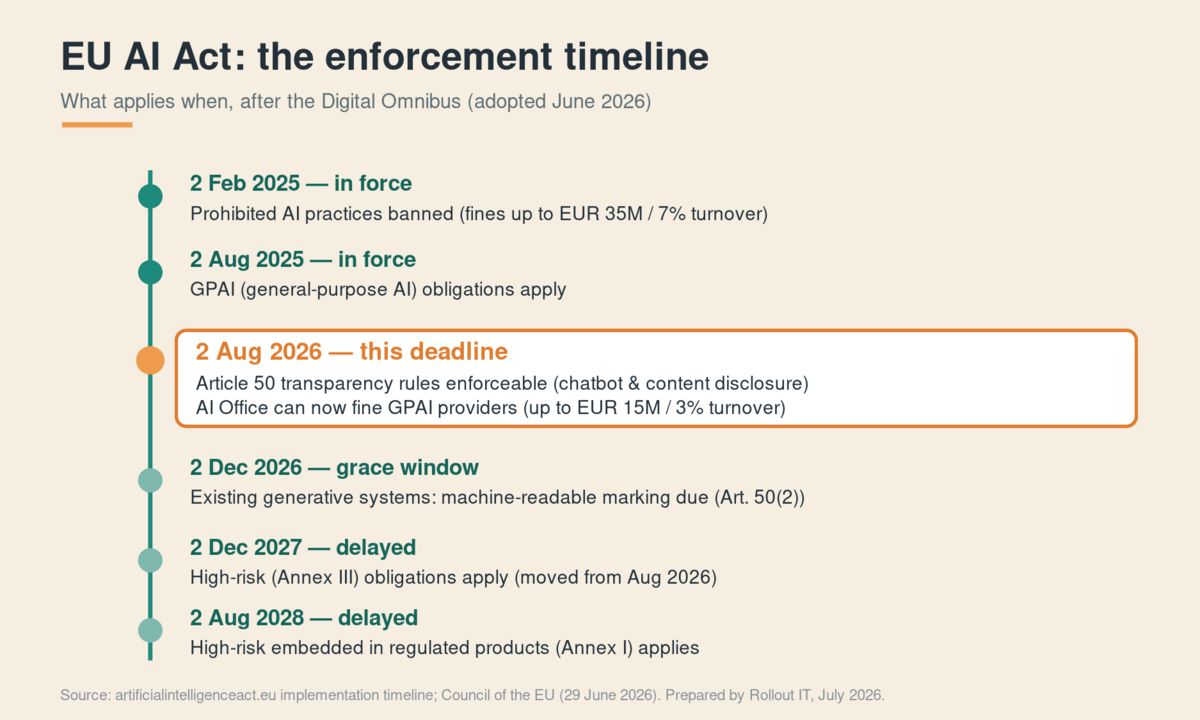
A useful nuance for teams already in the market: generative AI systems placed on the market before August 2, 2026 have until December 2, 2026 to meet the machine-readable marking requirement under Article 50(2). That is a short grace window, not a reprieve.
Wait, wasn’t August 2 the big high-risk deadline?
It was, until the Digital Omnibus moved it. The EU institutions adopted a simplification package that defers the most demanding high-risk obligations. The Council of the EU gave its final green light on June 29, 2026, following the European Parliament’s endorsement on June 16, 2026, and the act enters into force shortly after publication in the Official Journal.
Here is what the deferral actually does:
- Stand-alone high-risk systems (Annex III): obligations now apply from December 2, 2027 instead of August 2, 2026.
- AI embedded in regulated products (Annex I): obligations now apply from August 2, 2028.
Crucially, the Omnibus extended timelines and clarified how the AI Office and national authorities cooperate, but it left the fundamental architecture of the Act unchanged: the risk classifications, the core obligations, and the penalty structure all stand. It also added new prohibitions (for example, on AI tools that generate non-consensual intimate imagery). So this is timeline relief on high-risk, not a rollback of the law.
Does the EU AI Act apply to my company, including non-EU companies?
Yes, if your AI system’s output is used in the EU, the Act can reach you even if your company sits in the US, UK, or Canada. The AI Act is extraterritorial by design. It applies to providers placing AI systems on the EU market and to providers and deployers whose system output is used within the Union, regardless of where they are established.
For our clients expanding into Europe, this is the single most common misunderstanding we see. A SaaS company headquartered in North America that serves EU customers, or an AI feature whose results reach EU users, is in scope. Treating the AI Act as “an EU-only problem” is how teams end up retrofitting compliance under deadline pressure instead of building it in. Rollout IT helps companies plan this into their EU go-to-market from the start rather than as a late-stage fix.
What are the obligations for general-purpose AI (GPAI)?
GPAI providers must maintain technical documentation, publish a sufficiently detailed summary of training data, put a copyright policy in place, and (for models posing systemic risk) perform model evaluations and report serious incidents. These duties have applied since August 2, 2025; what is new on August 2, 2026 is that the AI Office can now enforce them with fines.
If you build on top of a foundation model rather than training your own, most of these duties sit with the upstream provider. But you still inherit downstream transparency duties under Article 50 whenever your product generates content or interacts with users, so “we just use the API” does not remove you from scope.
What counts as a high-risk AI system, and what’s the new deadline?
High-risk systems are those listed in Annex III (for example, AI used in recruitment, credit scoring, education access, or critical infrastructure) and AI embedded as a safety component in regulated products under Annex I. After the Omnibus, stand-alone Annex III systems must comply by December 2, 2027, and Annex I embedded systems by August 2, 2028.
The extra runway is genuinely useful, but it is not idle time. High-risk conformity is the heaviest lift in the Act: risk management systems, data governance, logging, human oversight, and conformity assessment. Teams that treat December 2027 as “later” tend to discover the work is 12 to 18 months long once data lineage and documentation are honest. Our experience delivering in regulated finance and health settings is that the winners start the data-governance groundwork now and let the transparency work this summer double as a rehearsal.
What are the penalties for non-compliance?
The AI Act uses a three-tier penalty structure, and the numbers are large enough to be a board-level concern:
| Violation type | Maximum fine |
|---|---|
| Prohibited practices (Article 5) | €35 million or 7% of global annual turnover, whichever is higher |
| High-risk and transparency violations | €15 million or 3% of global annual turnover, whichever is higher |
| Supplying misleading information to authorities | €7.5 million or 1% of global annual turnover, whichever is higher |
For the August 2, 2026 milestone specifically, the relevant exposure is the transparency tier: up to €15 million or 3% of worldwide turnover. Prohibited practices (which carry the 7% ceiling) have been banned since February 2, 2025. For SMEs and startups, fines are capped at the lower of the fixed amount or the percentage, a proportionality adjustment worth knowing if you are early-stage.
How should software teams prepare? A practical readiness checklist
The good news is that the August 2, 2026 obligations are scoped and achievable if you act now. Here is the sequence we use with clients:
- Inventory your AI touchpoints. List every place your product interacts with a person or generates or manipulates content. Chatbots, voice, image and video generation, text summarisation, and synthetic media all trigger Article 50.
- Confirm your EU exposure. If any output reaches EU users, assume you are in scope and document the reasoning.
- Ship the disclosures. Add clear “you are talking to an AI” notices, and implement content marking for generated media, including machine-readable provenance where feasible (for example, C2PA-style content credentials).
- Map the grace window. For generative systems already live, plan the machine-readable marking work to land before December 2, 2026.
- Clarify provider vs deployer duties. Document which obligations sit upstream (your model vendor) and which are yours as the deployer.
- Start the high-risk groundwork. If any system is Annex III, begin data governance, logging, and documentation now so December 2027 is a formality, not a scramble.
- Assign ownership. Name an accountable owner for AI Act compliance and a review cadence, because the timelines and guidance are still moving.
Most of this is engineering and documentation work, not legal theory, which is exactly where an experienced delivery partner shortens the path.
How Rollout IT builds compliant AI in regulated sectors
Compliance is easiest when it is designed in, not bolted on, and that is how we work with regulated-industry clients. In finance and health, we have delivered under exactly the kind of security, auditability, and data-governance pressure the AI Act now formalises. For iXLayer, a US digital-health platform, our engineers scaled an integration-heavy, multi-tenant system to enterprise reliability over a multi-year partnership. For major banks including Erste and a large post-merger Hungarian institution, we supplied senior engineering into environments where regulatory compliance and data security are non-negotiable.
That background shapes how we approach the AI Act: transparency disclosures and content marking implemented cleanly in the product, provider-versus-deployer duties documented, and (for high-risk systems) the data-governance and logging foundations laid early. It also connects to how we help clients deliver responsible AI features in the first place, from RAG grounding and source citation to monitoring, in our AI development and AI transformation work. For universities navigating the same rules, our higher-education practice covers EU AI Act compliance for institutions directly.
The pattern we see across sectors is consistent: teams that treat August 2, 2026 as a forcing function to get their AI inventory, disclosures, and governance in order come out of it faster and calmer, and far better positioned for the heavier high-risk deadlines in 2027 and 2028.
Frequently asked questions
When does the EU AI Act take effect?
It applies in stages. Prohibited practices have been banned since February 2, 2025, and GPAI obligations since August 2, 2025. Article 50 transparency rules and GPAI enforcement start on August 2, 2026. After the Digital Omnibus, high-risk obligations apply from December 2, 2027 (Annex III) and August 2, 2028 (Annex I embedded in regulated products).
Does the AI Act apply to US, UK, or Canadian companies serving the EU?
Yes. The Act is extraterritorial. If your AI system is placed on the EU market or its output is used in the EU, you are in scope regardless of where your company is based.
What is the fine for breaking the EU AI Act?
Up to €35 million or 7% of global turnover for prohibited practices, up to €15 million or 3% for high-risk and transparency violations, and up to €7.5 million or 1% for supplying misleading information. SMEs and startups face the lower of the fixed amount or the percentage.
Is the high-risk deadline delayed?
Yes. The Digital Omnibus, adopted in June 2026, moved stand-alone high-risk (Annex III) obligations to December 2, 2027 and embedded high-risk (Annex I) to August 2, 2028. The August 2, 2026 transparency and GPAI-enforcement milestone was not delayed.
Sources: EU AI Act implementation timeline; Article 50 transparency obligations; Article 99 penalties; Council of the EU: final green light to simplify AI rules (June 29, 2026); Gibson Dunn: EU AI Act Omnibus Agreement; Sidley Data Matters: preparing for August 2, 2026 transparency obligations.