
FinTech Staff Augmentation: Scaling Engineering Without the Hiring Lag (2026)
FinTech staff augmentation is the practice of adding pre-vetted, senior engineers to your existing team on a flexible, contract basis, so you scale delivery in weeks instead of the months a permanent hire takes. For financial companies facing a compliance-driven talent crunch, it closes the gap between roadmap ambition and hiring reality without handing over control of the product.
That control is the point. Unlike full outsourcing, augmented engineers work inside your team, under your direction, on your stack. Below we explain when it makes sense for a FinTech, how to keep augmented teams compliant with rules like DORA, what it costs versus hiring, and how fast people can actually start.
What is FinTech staff augmentation?
FinTech staff augmentation means bringing in external, specialist engineers who integrate directly into your in-house team rather than working at arm’s length. Rollout IT sources, screens, and technically vets each candidate, then embeds them into your workflows, tooling, and rituals. You keep day-to-day management and product ownership; the partner handles sourcing, contracts, and ongoing performance support in the background.
The model matters more in finance than in most sectors because the work is security-critical and regulated. You are not just adding hands; you are adding people who can pass a bank’s security review, work under audit conditions, and write code that end users depend on for their money. That is a narrower talent pool than general web development, and it is exactly where a specialist partner earns its place.
When should a FinTech scale with staff augmentation vs. hiring or a dedicated team?
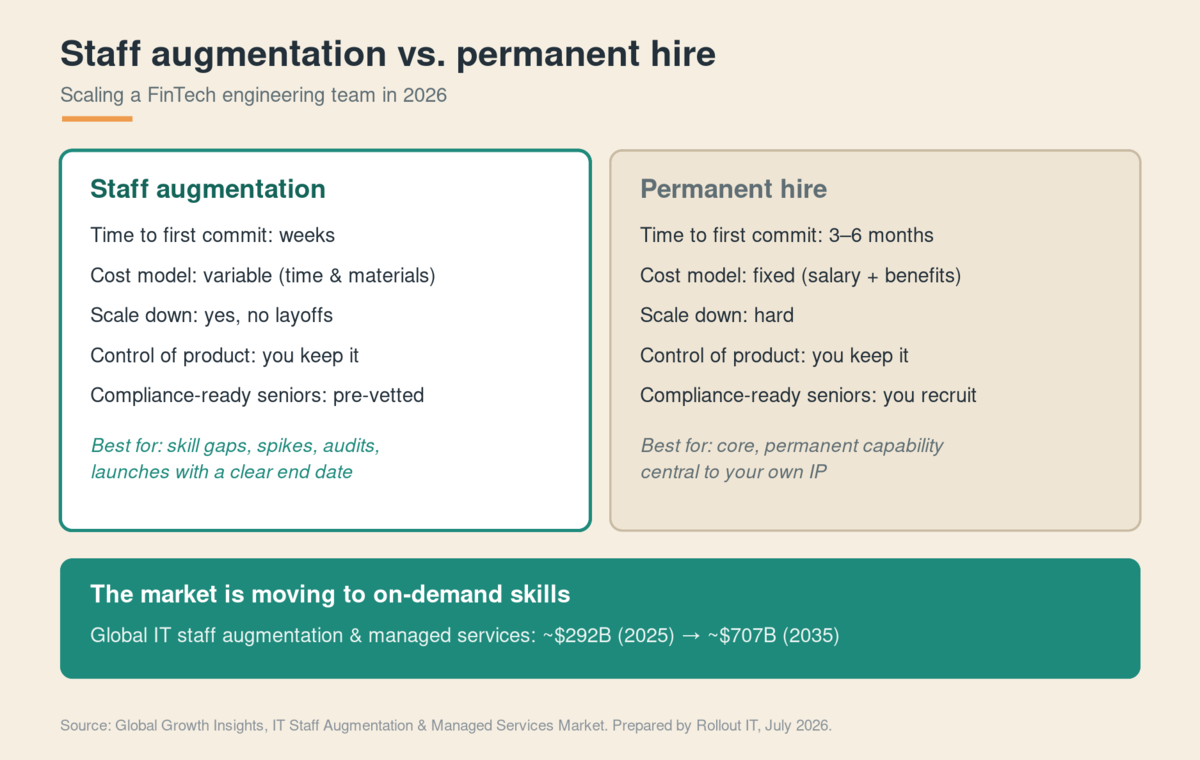
Choose staff augmentation when you need specific senior skills quickly, for a defined period, without losing control of delivery. Choose permanent hiring when the need is long-term core capability you must own. Choose a fully managed dedicated team when you want a partner to own an entire workstream end to end. The three are not mutually exclusive, and most scaling FinTechs use a blend.
Here is the practical decision view:
| Situation | Best fit | Why |
|---|---|---|
| Roadmap is slipping because a senior skill is missing now | Staff augmentation | Weeks to onboard, no long-term headcount commitment |
| Demand spike (migration, audit, launch) with a clear end date | Staff augmentation | Scale up and down without layoffs |
| Core, permanent capability central to your IP | Permanent hire | Long-term ownership and culture |
| A whole feature or platform someone else can own | Dedicated / managed team | Outcome accountability, less management overhead |
The 2026 market backdrop favours the flexible options. The global IT staff augmentation and managed services market is projected to roughly grow from about $292 billion in 2025 to over $707 billion by 2035, driven by exactly this need for on-demand specialist skills. Buyers are also shifting from headcount-based to skills-based sourcing, which is precisely what regulated FinTech work rewards.
How do you keep augmented teams DORA- and security-compliant?
You keep augmented teams compliant by treating security and governance as part of onboarding, not an afterthought: pre-vetted engineers, contractual confidentiality, least-privilege access, and integration with your existing controls. Since January 2025, the EU’s Digital Operational Resilience Act (DORA) has made third-party ICT risk a board-level concern for financial entities, and augmented engineers fall squarely inside that scope.
In practice, that means a few non-negotiables. Access should be scoped and revocable. The partner should operate under a B2B service agreement that is flexible with your internal compliance standards. And the engineers themselves should already understand regulated delivery, because a developer who has shipped inside a bank does not need to be taught what an audit trail is for. This is where sourcing from a partner with real financial-sector delivery experience de-risks the whole engagement. It is the difference between adding a contractor and adding a colleague who happens to be external.
What does FinTech staff augmentation cost vs. in-house hiring?
Staff augmentation is usually billed on a transparent time-and-materials basis, so you pay for actual days worked, with rates set by seniority, role, and tech stack. The headline day rate can look higher than an equivalent salary line, but the true comparison has to include the full cost and risk of hiring.
A permanent senior hire in finance carries recruitment fees, months of time-to-productivity, benefits, equipment, and the standing cost of that salary even when the roadmap quietens down. Augmentation converts that fixed cost into a variable one. The way we structure it at Rollout IT, there are no hidden onboarding fees and no surprise charges for ramp-up or early offboarding, so the budget is predictable. For teams that want optionality, a “try and hire” arrangement lets you work with an engineer on time-and-materials first and bring them in-house later if the fit is right.
The real saving is speed. Every month a revenue-driving feature waits on an open role is a month of opportunity cost that rarely shows up on the hiring spreadsheet but hits the business hardest.
How fast can you onboard augmented FinTech engineers?
Augmented engineers typically start in a matter of weeks, not the three-to-six months a permanent finance hire often takes from job posting to first commit. Because candidates are already sourced and technically screened, the timeline is dominated by your access provisioning and security onboarding rather than by recruiting.
The four-step process we use keeps that fast without cutting corners: a discovery and role brief to define the exact skills and expectations; sourcing and multi-stage technical screening from an EU talent pool; onboarding and integration with secure access aligned to your workflows; then continuous check-ins and performance tracking. The screening is deliberately strict, including culture and soft-skill fit, so you only meet candidates who are genuine matches.
Proven in FinTech and regulated delivery
We do not position ourselves as a FinTech staff augmentation partner in the abstract; it is what we have done for banks and health platforms under real compliance pressure. The examples below are drawn directly from our delivery work.
For Erste, our senior developers joined the Erste Netbank frontend team and lifted quality and delivery speed, introducing reactive programming patterns and predictable state management across a personal-banking platform that handles account management and transfers. For the MBH Bank merger, one of the largest banking consolidations in Hungary, we supplied senior backend, DevOps, and program-management capacity into a fully remote organisation of around 300 engineers, helping build a unified, microservice-based digital bank. For iXLayer, a US digital-health platform, we embedded three full-stack engineers for more than two years to scale an integration-heavy, multi-tenant system to enterprise reliability.
Three different problems, one pattern: senior people who could operate inside regulated, security-critical environments from day one. That is the promise of FinTech staff augmentation done well, and it is why financial clients keep working with us across multi-year engagements rather than one-off sprints. If you want the wider view of how we approach security, speed, and precision in financial software, our FinTech practice page goes deeper.
The takeaway for engineering leaders: when the constraint is senior, compliance-ready talent and the clock is the enemy, augmentation is the fastest way to protect the roadmap without compromising on control or security.
Sources: Rollout IT — Staff Augmentation; Rollout IT — FinTech; Rollout IT — Erste Netbank case study; Rollout IT — Build the future bank (MBH); Rollout IT — iXLayer case study; Global Growth Insights — IT Staff Augmentation & Managed Services Market.