
Vertical LLMs: Domain-specific AI, why it beats general models in 2026
Vertical LLMs are language models specialised for one industry or function, trained or adapted on domain data, terminology, and rules so they outperform general models on regulated, high-stakes tasks. In 2026 enterprises are adopting them because accuracy, compliance, and cost matter more than raw breadth. This article explains where domain-specific AI wins and how to choose between vertical models, fine-tuning, and RAG.
What are vertical LLMs (vs general models)?
Vertical LLMs are domain-specific models tuned to the language, workflows, and constraints of a single sector such as finance, healthcare, law, or education. Unlike a general LLM built to answer anything, a vertical LLM is optimised to be reliably correct inside a narrow, high-value domain where a wrong answer carries real regulatory or financial cost.
The distinction is not just the training data. A vertical model is shaped end to end: the evaluation set reflects real domain edge cases, guardrails encode sector rules (KYC, FERPA, EU AI Act), and outputs are formatted for the systems compliance teams already use. General models are generalists that impress in demos. Vertical AI agents are specialists that hold up in audits.
In practice, “vertical LLM” is an umbrella. It covers fully domain-trained models, fine-tuned LLM enterprise variants, small language models for enterprise deployment, and general models wrapped in retrieval and tight guardrails. What unites them is intent: solve one industry’s problem accurately, not every problem approximately.
Why are enterprises shifting to domain-specific AI in 2026?
Enterprises are shifting to domain-specific AI because general models plateau exactly where regulated work gets hard: precise terminology, defensible sourcing, and predictable behaviour. The market data now reflects that shift. Gartner predicts that by 2026, 80% of enterprises will have adopted vertical AI agents, a signal that specialisation has moved from experiment to default.
The trajectory is steep. According to industry analysis, more than half of enterprise generative AI models will be domain-specific by 2027, up from roughly 1% in 2024. That is one of the fastest reversals in enterprise software: from a rounding error to the majority in three years.
Spending is following capability. In 2025, US enterprise generative AI spend reached around $37 billion, with vertical AI already capturing about $3.5 billion of it. The pattern Rollout IT sees in client conversations matches the numbers: budget owners in regulated sectors no longer ask “can AI do this,” they ask “can this pass review.” Vertical AI vs general LLM is increasingly decided by compliance, not by benchmark leaderboards.
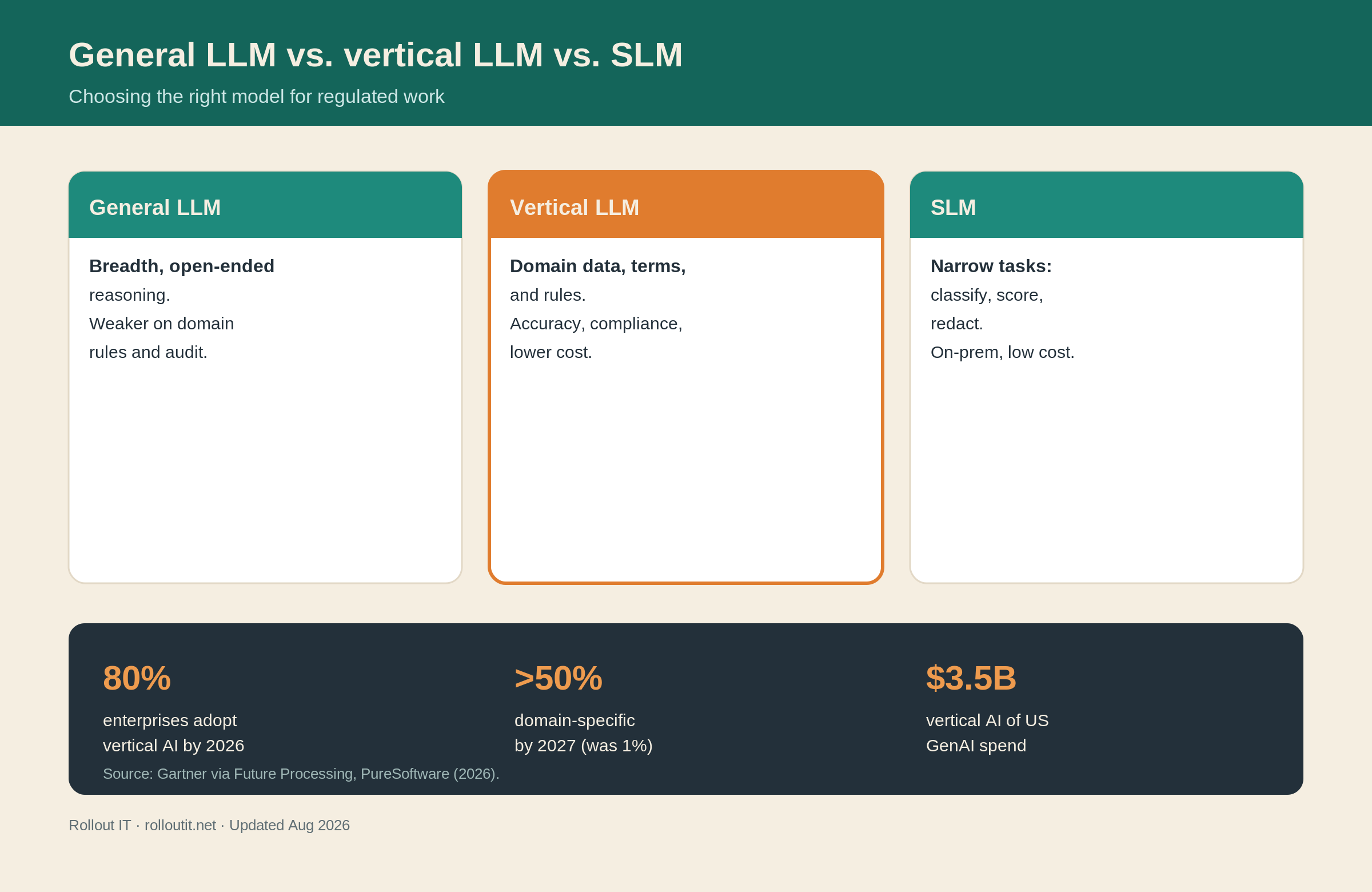
ALT: Bar chart showing domain-specific models rising from about 1 percent in 2024 to over 50 percent of enterprise GenAI by 2027.
Where do vertical LLMs and small language models win?
Vertical LLMs win wherever a wrong answer is expensive, auditable, or both. The clearest gains show up in finance, healthcare, legal, and education, where language is dense with regulation and accuracy is not optional. Small language models for enterprise use add a second advantage: they run cheaper, faster, and often on-premises, which matters when data cannot leave a controlled environment.
Finance and FinTech. Risk classification, transaction monitoring, KYC/AML review, and customer support all reward a model that knows the vocabulary and the rules. A general model may summarise a regulation; a vertical model applies it consistently and cites its source. This is the domain where Rollout IT has shipped risk classification and scoring work for FinTech clients.
Healthcare. Clinical and digital-health workflows demand grounded, source-referenced answers and strict data handling. Vertical models constrained by retrieval reduce hallucination on medical terminology and keep patient data inside compliant boundaries.
Legal. Contract analysis and compliance research need traceable citations, not confident guesses. Domain-specific AI that always shows its source is far more useful to a legal team than a broader model that cannot.
EdTech. Course generation, adaptive tutoring, dropout prediction, and ECTS-aligned content benefit from models tuned to pedagogy and to education-specific compliance such as FERPA and the EU AI Act. This is core Rollout IT territory through its EdTech unit and the datadrivenuni.com higher-education work.
Small language models deserve their own line. When a task is narrow, a compact fine-tuned model can match a giant general model at a fraction of the cost and latency, which is why small language models for enterprise deployment are now a serious part of the vertical AI conversation.
Vertical LLM vs fine-tuning vs RAG: how to choose
The most common mistake is treating these as competitors. They are three layers of the same decision. Use the framework below to match approach to problem before committing budget.
| Approach | Best when | Strengths | Watch-outs | Typical regulated use |
|---|---|---|---|---|
| RAG (retrieval on a general model) | Knowledge changes often; you need traceable sources; data must stay grounded | Fast to ship, always-current, source citations, lower build cost | Only as good as your knowledge base; retrieval quality is the ceiling | Policy Q&A, support assistants, internal knowledge search |
| Fine-tuned LLM (enterprise) | You need domain tone, format, and edge-case behaviour repeated reliably | Consistent style and structure, better on niche terminology, works offline | Needs quality labelled data; must be re-tuned as the domain drifts | Structured extraction, classification, drafting in a fixed format |
| Small language model (SLM) | Task is narrow; cost, latency, or on-prem/data-residency matters | Cheap, fast, deployable in controlled environments, easy to govern | Narrower range; not for open-ended reasoning | On-device or in-VPC classification, scoring, redaction |
| Dedicated vertical LLM | The whole workflow is domain-critical and high-volume | Deepest domain accuracy, strongest compliance fit | Highest build and maintenance cost; only justified at scale | Core risk engines, clinical assistants, sector platforms |
Rollout IT’s rule of thumb: start with RAG for grounding, add fine-tuning where behaviour must be consistent, drop to a small language model where cost and data residency dominate, and reserve a dedicated vertical LLM for the workflows that are both high-volume and mission-critical. Most regulated deployments end up as a blend, not a single choice. We scope that blend through our custom AI development and AI transformation work.
What does it take to build or adopt a vertical LLM?
Building a vertical LLM takes less model-training heroics and more disciplined data, evaluation, and governance. The model is rarely the hard part in 2026. The hard part is assembling clean domain data, defining what “correct” means, and proving it stays correct under audit.
A practical adoption path looks like this:
1. Frame the domain task. Pick one high-value workflow with a measurable outcome (fewer false positives, faster review, higher retention). Vague scope kills vertical projects.
2. Assemble and clean domain data. Gather the documents, labels, and edge cases that represent real work, then remove noise and resolve licensing and privacy.
3. Choose the layer. Apply the table above: RAG, fine-tune, SLM, or a dedicated vertical model, or a blend.
4. Build the evaluation set first. Define domain-specific tests and a rejection policy before shipping, so accuracy is provable, not assumed.
5. Engineer guardrails and grounding. Source citations, confidence scores, and a safe refusal when evidence is thin. In regulated sectors, a model that says “I am not sure” beats a confident wrong answer.
6. Monitor and re-tune. Live monitoring, anomaly detection, and a feedback loop back into the knowledge base, because domains drift and regulations change.
This is precisely the trust and accuracy discipline Rollout IT applies across delivery: RAG verification, source references with confidence scores, targeted fine-tuning for domain depth, and continuous monitoring.
How Rollout IT builds domain-specific AI in FinTech and EdTech
Rollout IT builds vertical AI where it has genuine domain depth: regulated FinTech and EdTech. With 10+ years, 50+ projects, and 30+ experts across the EU (Hungary) and the US, the team treats domain-specific AI as an engineering and compliance problem, not a demo.
In FinTech, Rollout IT has delivered risk classification, scoring improvements, and secure delivery for clients including Erste Bank, MBH Bank, and ixlayer, where security, speed, and precision are non-negotiable because end users depend on the platform.
In EdTech, a dedicated unit plus a Data Lake team supports work such as dropout prediction, AI course and quiz generation, and adaptive tutoring, with FERPA, GDPR, and EU AI Act compliance built in. The higher-education microsite datadrivenuni.com extends this to dropout prediction, ECTS course generation, and AI Act compliance for universities, alongside client work with Labster and Skillbandit.
The through-line is human-first delivery: models tuned to a client’s workflow, grounded in their data, and governed so they hold up in review. That is what separates a vertical LLM that ships from a general model that only demos well. To see how the same grounding discipline powers search, read our piece on natural language search.
Frequently asked questions
What is a vertical LLM?
A vertical LLM is a language model specialised for one industry or function. It is trained or adapted on domain data, terminology, and rules so it is reliably accurate on high-stakes, regulated tasks, unlike a general model built to answer anything.
Vertical AI vs general LLM: which is better for enterprises?
Neither is universally better. General LLMs win on breadth and open-ended reasoning; vertical AI wins on accuracy, compliance, and cost inside a specific domain. Regulated enterprises usually choose vertical AI because it passes audit and controls risk.
Is fine-tuning or RAG better for a domain-specific LLM?
They solve different problems. RAG grounds answers in current, citable knowledge and ships fast. Fine-tuning makes behaviour, tone, and format consistent for repeated tasks. Most regulated deployments combine both, and add a small language model where cost or data residency matters.
What are small language models good for in enterprise?
Small language models suit narrow tasks where cost, latency, or on-premises data residency matter, such as classification, scoring, or redaction inside a controlled environment. They can match large general models on focused work at a fraction of the cost.
How fast is enterprise adoption of vertical AI?
Very fast. Gartner predicts 80% of enterprises will have adopted vertical AI agents by 2026, and more than half of enterprise generative AI models are expected to be domain-specific by 2027, up from roughly 1% in 2024.
How does Rollout IT prevent hallucination in vertical LLMs?
Through RAG verification against pre-verified documents, source references with confidence scores, a safe refusal policy when evidence is thin, domain fine-tuning, and continuous monitoring with a feedback loop, applied across FinTech and EdTech delivery.