
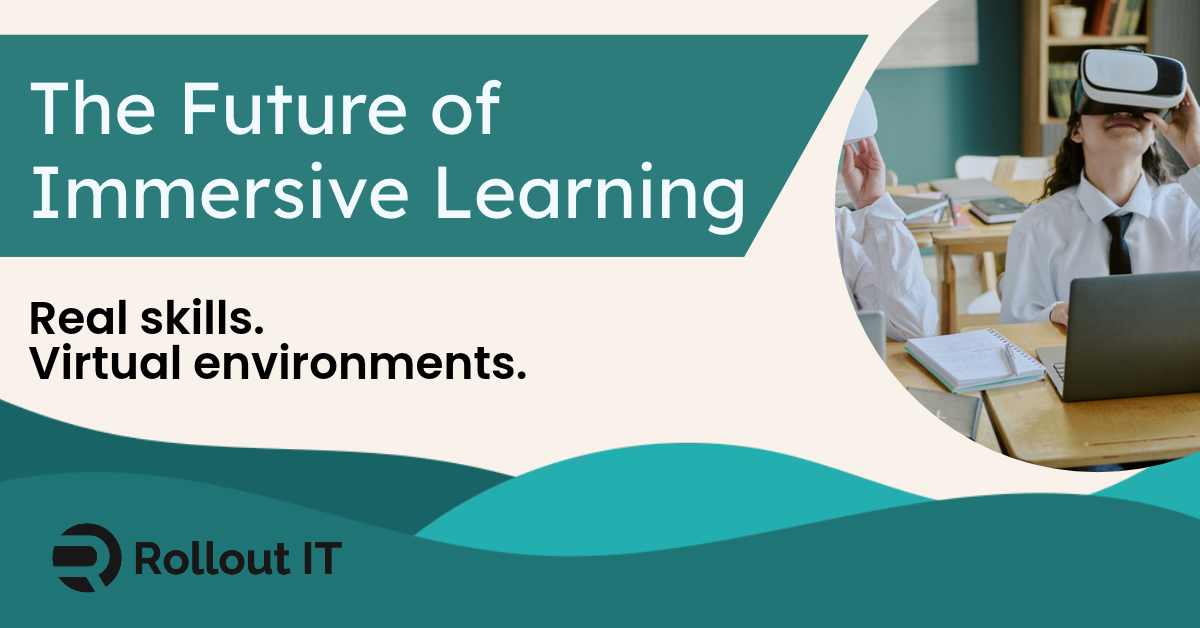
AI and AR VR in Education: Real Use Cases for 2026
AI and AR/VR work best in education when they solve a learning problem that flat content cannot solve: safe practice, spatial understanding, adaptive feedback or repeated simulation. The winning products in 2026 will not be generic virtual classrooms. They will be focused learning tools that combine immersive practice with measurable learner data.
What AI and AR VR actually change in education
AR and VR give learners an environment to practice in. AI makes that environment respond to the learner. Together, they can support virtual labs, clinical decision training, safety simulations, language practice, industrial maintenance training and adaptive onboarding for complex systems.
The technology is useful when the real-world task is expensive, dangerous, hard to repeat or difficult to visualize. The XR Association uses a helpful DICE lens for these cases: Dangerous, Impossible, Counterproductive or Expensive experiences are stronger candidates for immersive learning than topics that can be taught well with video, text or a simple quiz.
EDUCAUSE’s 2026 Horizon Report also points to the broader pressure on higher education: institutions need to prove value while AI changes assessment, instructional design and student support. That makes measurement as important as immersion. A simulation that looks impressive but cannot show learning progress will struggle to win the budget.
Where immersive learning creates real value
The best use cases sit close to performance, not entertainment. In healthcare, learners can practice decisions before touching patients. In science education, virtual labs can let students repeat experiments that are too expensive or unsafe to run physically. In skilled trades, learners can rehearse hazardous scenarios before entering the workplace.
XRA’s 2026 report describes a Wyoming initiative that delivered 6625 immersive learning sessions across nine higher education institutions and reached 2764 students. It also reports that 98 percent of faculty who used XR continued using it, and around 80 percent of usage became required coursework by the second semester. That is the important signal: adoption sticks when the experience fits a real course objective.
How AI makes immersive learning more useful
AI should not be added as decoration. Its value is in adaptation, feedback and analytics. A well-designed AI layer can change scenario difficulty, identify misconceptions, generate practice variations, summarize learner behavior and help instructors see who needs support.
| AI capability | Immersive learning use | Product requirement |
| Adaptive scenarios | Change difficulty based on learner choices | Clear learning objectives and event tracking |
| Feedback generation | Explain why a choice was safe, risky or incomplete | Grounded rubrics and instructor review |
| Learner analytics | Show progress across repeated simulations | Dashboards tied to course outcomes |
| Content variation | Generate new cases from approved templates | Human approval and version control |
| Support assistant | Answer questions inside the learning flow | RAG over trusted course materials |
What it takes to build an AI powered immersive learning product
A serious product needs more than a headset prototype. It needs instructional design, content operations, LMS integration, user management, data privacy, accessibility, device strategy, analytics and support for faculty or trainers. The product team should start with one repeatable learning objective, not an entire virtual campus.
1. Define the learning task and what success looks like.
2. Decide whether the experience needs VR, AR, WebXR or a 3D web simulation.
3. Map the learner events that must be captured for feedback and analytics.
4. Build the first scenario with instructor review built into the workflow.
5. Integrate with LMS, identity, grading and reporting systems only after the core experience proves value.
What EdTech leaders should avoid
The main mistake is starting with hardware. Device choice matters, but it should follow the learning objective. A browser-based 3D simulation may be enough for many institutions. VR may be worth it for spatial practice or embodied tasks. AR may be stronger when learners need digital guidance in a physical environment.
The second mistake is ignoring instructors. Faculty need training, templates, support and a way to fit the tool into existing coursework. XRA’s report makes this point clearly: access to technology alone is not enough.
How Rollout IT fits this type of EdTech build
Rollout IT’s EdTech work focuses on scalable architecture, LMS integration, secure infrastructure, AI integration and student engagement. That matters because immersive learning products live inside an institutional ecosystem. They must connect to Canvas, Moodle or other platforms, respect GDPR and accessibility expectations, and scale without turning every new scenario into a custom engineering project.
A practical first project would be a focused virtual lab or scenario engine with learner analytics, instructor controls and one clear integration path. From there, the product can grow based on usage data rather than hype.
Frequently asked questions
How is AI combined with AR VR in education
AI can personalize scenarios, generate feedback, analyze learner behavior and help instructors identify gaps. AR and VR provide the immersive practice environment where those interactions happen.
What are the best use cases for AI and AR VR in education
The strongest use cases are virtual labs, clinical training, safety simulations, spatial learning, technical maintenance training and scenarios that are expensive or risky to repeat in real life.
Is immersive learning worth the cost
It is worth considering when the learning task benefits from practice, repetition and measurement. It is usually not worth it for simple content delivery that a video, quiz or LMS module can handle well.
What should an EdTech team build first
Start with one measurable learning objective and one scenario. Prove that learners and instructors use it before expanding into a broader immersive platform.
Sources
· Rollout IT EdTech: https://rolloutit.net/edtech/
· HolonIQ education insights: https://www.holoniq.com/education