
What Is an AI-Native Agency and Why Does It Matter?
For decades, the agency model has run on a single growth lever: headcount. Win a client, staff a team, deliver the work, repeat. Margins stay thin, utilisation rates stay stressful, and revenue is permanently tethered to the number of people on the payroll.
The same headcount trap shows up in the tools teams buy: per-seat SaaS charges more with every hire, which is why a growing number of firms now choose software you own instead of renting per seat.
In its Spring 2026 Request for Startups, Y Combinator signalled that this era is ending. YC listed the AI-native agency as a priority investment category and this is not AI tools bolted onto existing workflows, but service businesses rebuilt from the ground up around artificial intelligence as the primary delivery mechanism. For CTOs, product owners, and innovation leaders, understanding this shift is now a strategic necessity.
What is the AI-native service model and how does it differ from AI-assisted?
Most agencies today use AI for drafting proposals, generating first-pass creative, or accelerating research. That makes them AI-assisted. It does not make them AI-native. The distinction is architectural: AI is not a tool the team reaches for but it is the primary execution layer. Humans design, govern, and refine the systems. The systems do the work.
YC’s Aaron Epstein framed the logic plainly as agencies have always been difficult to scale because the only way to grow was to add people but AI changes that equation entirely. A design firm that delivers a complete creative concept before the contract is signed, or a legal practice that drafts complex documents in minutes rather than weeks, in each case, the economics look more like a software company than a service firm.
Why is the AI-native service model splitting agencies in two?
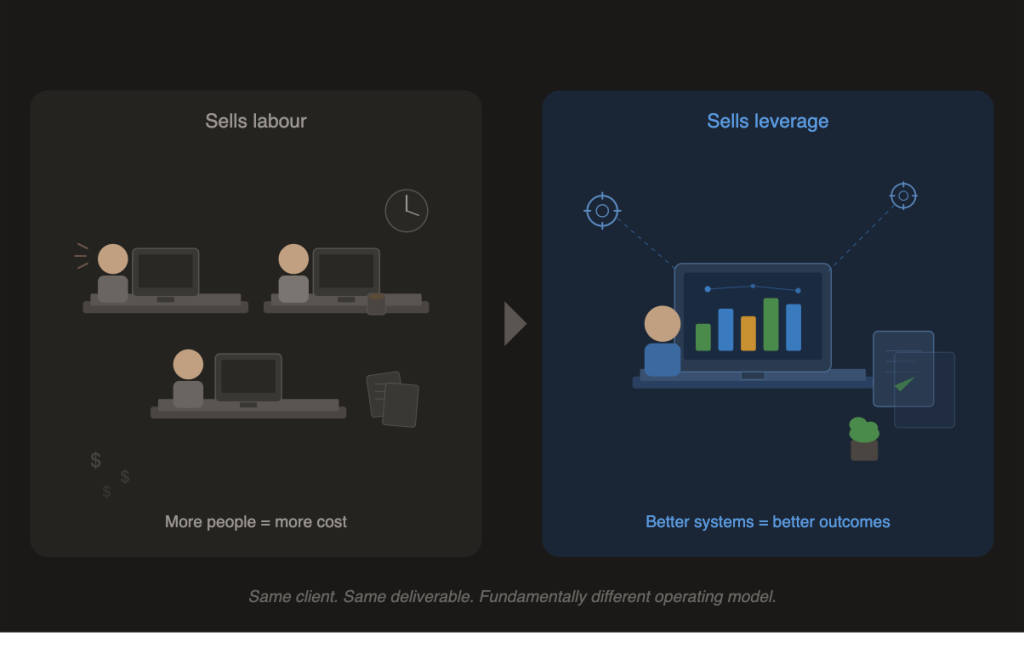
Jacob Klug, co-founder of Creme Digital and a closely watched operator in the AI-native agency space, crystallised the coming divide shortly after YC’s announcement: the agency model is splitting into businesses that sell labour and businesses that sell leverage. Only one survives long-term.
Labour vs. leverage: two fundamentally different agency models
Same industry. Entirely different economics, risk, and scalability.
| Dimension | Traditional Agency | AI-Native Agency |
| Growth lever | Hiring more people | Scaling AI systems |
| Margin profile | Thin, labour-bound | Software-like, expanding |
| Speed to value | Weeks (discovery + ramp-up) | Days (system-generated first pass) |
| Knowledge retention | Held by individuals | Encoded in architecture |
| Pricing model | Time-and-materials | Outcome-based |
| Human role | Task execution | System governance + strategy |
Same service category. One model compounds; the other caps out at headcount.
An agency that sells labour is fundamentally constrained. Capacity scales with hiring. Costs scale with salaries. Institutional knowledge exits when senior staff leave. An agency that sells leverage identifies workflows clients overpay for, builds AI systems that execute those workflows at dramatically higher speed, and progressively converts repeated manual effort into proprietary intellectual property. The endpoint is selling the outcome, not the time.
What do enterprise leaders risk by ignoring this shift?
Previous automation waves of cloud computing, offshore delivery, workflow tools were absorbed as incremental efficiency gains. The current AI inflection is structurally different. Modern AI systems generate professional-quality creative, draft complex technical documentation, synthesise strategic insights from unstructured data, and manage multi-step conditional workflows.
For enterprise buyers, selecting a partner that has merely layered AI tools onto a legacy operating model while competitors engage a genuinely AI-native agency. The gap between the two is already measurable in speed, cost, and output quality and it will widen rapidly over the next twelve to eighteen months.
How does AI-native delivery change procurement decisions?
- Speed to value is structurally different: Traditional engagements begin with discovery phases, team ramp-up, and iterative cycles measured in weeks. AI-native workflows compress these dramatically system-generated first passes allowing human experts to operate at the review-and-refinement layer rather than the creation layer.
- Proprietary systems compound over time: Each engagement refines the provider’s internal AI-powered service delivery systems. Institutional knowledge is encoded in architecture, not held in individual heads by creating a fundamentally different risk profile for long-term partnerships.
- Outcome-based pricing becomes viable: When delivery is system-driven, providers can price on results of a completed feature, a campaign, a shipped product rather than time-and-materials.
- The human layer moves up the value chain: AI-native does not mean human-free. It means every team member operates at the strategic, architectural, and quality-assurance layers where domain expertise genuinely matters.
Where does custom AI development fit in this picture?
For organisations building their own products, the rise of the AI-native agency is an architectural decision. This is precisely where AI development capabilities that combine deep technical architecture with AI system design become a genuine differentiator.
Building AI-native requires more than API access. It demands understanding non-deterministic outputs, designing appropriate human oversight, managing training data governance, and architecting systems that improve rather than degrade over time.
Conclusion
YC’s endorsement validates a category that is already forming. This model rewards early movers, and the window will not stay open indefinitely. Evaluate your current providers: ask how their AI systems are governed, ask what happens to institutional knowledge after your engagement, and ask how they measure system performance over time.
The companies that get this right in 2026 will hold a structural advantage that compounds their systems’ learning, their workflows improve, and their delivery economics scale in ways traditionally-built competitors cannot match. The model has changed. The question is whether your partnerships have. Speak with our AI-native development experts or explore our market expansion services to start building your AI-native development roadmap.