
EU Market Entry Strategy: The 180-Day Asia-EU Scaling Blueprint
Breaking into Europe is no longer just a growth milestone but it is a strategic inflection point. For Asian tech companies, the European market offers scale, regulatory maturity, and long-term stability. Yet, the complexity of compliance, cultural diversity, and go-to-market execution often slows momentum.
What if this process could be compressed into a disciplined, risk-aware, 180-day plan?
This article outlines a structured EU market entry strategy designed specifically for scaling Asian tech companies, enabling a controlled yet ambitious European market expansion within six months. The goal is not speed at the cost of precision but speed through clarity, sequencing, and execution discipline.
Why does a 180-day EU market entry strategy work?
A six-month timeline forces prioritization. It removes unnecessary delays and aligns leadership teams around measurable outcomes. More importantly, it creates a balance between validation and execution, ensuring that companies move forward with confidence rather than assumption.
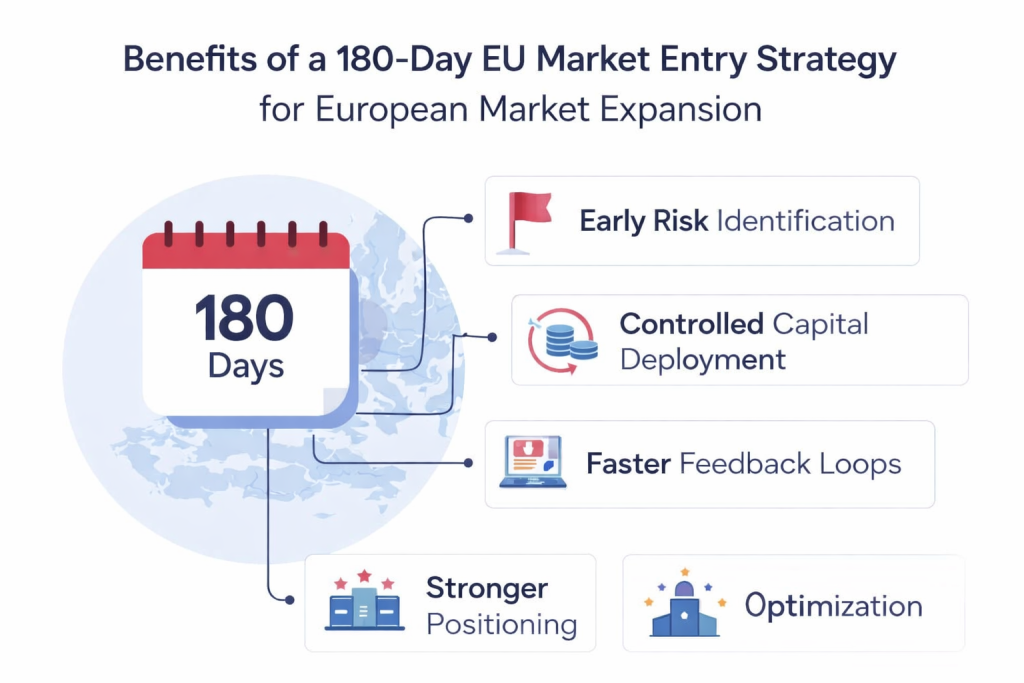
A well-designed EU market entry strategy within 180 days enables early risk identification, controlled capital deployment, faster feedback loops, and stronger positioning against incumbents. For organizations used to high-growth Asian markets, this model preserves execution speed while adapting to European operational realities.
The 180-day market entry plan at a glance
A phased execution model for clarity
| Phase | Timeline | Core Focus | Key Outcomes |
| Phase 1 | Days 1–30 | Market validation & compliance | Clear target market + regulatory readiness |
| Phase 2 | Days 31–60 | GTM strategy & positioning | Localized messaging + pricing strategy |
| Phase 3 | Days 61-90 | Entity setup & hiring | Operational foundation in place |
| Phase 4 | Days 91-120 | Pilot launch | Early traction + validated assumptions |
| Phase 5 | Days 121-150 | Partnerships & scaling | Channel expansion + market credibility |
| Phase 6 | Days 151-180 | Optimization & expansion | Scalable and repeatable growth model |
This structured breakdown ensures that scaling Asian tech companies maintain forward momentum without losing strategic direction.
EU market entry strategy phases for a 180-day market entry plan
A successful European market expansion requires more than ambition, it demands a structured and phased approach. For scaling Asian tech companies, a well-defined EU market entry strategy ensures that every step, from validation to scaling, is aligned with market realities and execution capabilities.
Phases of a 180-day market entry plan
- Phase 1: EU market entry strategy for market validation and regulatory mapping – In the first 30 days, the EU market entry strategy focuses on selecting 1–2 priority countries and mapping compliance requirements. The goal is rapid validation, identifying demand-solution fit while aligning with GDPR, local regulations, and certification needs to de-risk European market expansion early.
- Phase 2: EU market entry strategy for local positioning and GTM(Go To Market) design – This phase translates product value for European buyers. The EU market entry strategy emphasizes trust-led messaging, region-specific pricing, and clear channel choices (direct vs partner-led). For scaling Asian tech companies, localized GTM design is critical to conversion and early traction.
- Phase 3: EU market entry strategy for entity setup and infrastructure – Execution begins with legal setup, initial hiring, and core systems. The EU market entry strategy here ensures VAT-ready billing, compliant CRM, and a small, high-impact local team—creating a stable base for European market expansion.
- Phase 4: 180-day market entry plan for pilot launch and traction – A controlled pilot validates assumptions with real customers. The 180-day market entry plan uses tight feedback loops to refine product, pricing, and messaging, while early case studies and partnerships build credibility for the broader EU market entry strategy.
- Phase 5: Scaling Asian tech companies through partnerships – With validation in place, the focus shifts to scale via partnerships and targeted marketing. For scaling Asian tech companies, local distributors and integrators accelerate access, while region-specific campaigns strengthen positioning within the EU market entry strategy.
- Phase 6: European market expansion and optimization strategy – The final phase scales what works. The EU market entry strategy expands into adjacent markets using repeatable playbooks, while optimizing CAC(customer acquisition cost), LTV(lifetime value), and sales cycles to ensure sustainable European market expansion.
A structured 180-day market entry plan not only improves execution but also helps scaling Asian tech companies turn their EU market entry strategy into a repeatable growth engine for long-term European market expansion.
How do scaling Asian tech companies measure success in European market expansion?
Success in European market expansion is not defined by revenue alone, but by how efficiently and sustainably growth is achieved through a well-executed EU market entry strategy. Initially, performance is best evaluated using key metrics such as customer acquisition cost (CAC), lifetime value (LTV), sales cycle length, conversion rates, and market penetration.
CAC helps assess how cost-effective market entry efforts are, while LTV reflects the long-term value generated from each customer, particularly important in Europe, where relationships are often trust-driven and long-term. Sales cycle length provides insight into how quickly deals progress in structured and compliance-heavy environments, and conversion rates indicate how well positioning and messaging resonate with local buyers. Market penetration, meanwhile, shows how deeply a company has established itself within a specific segment, which is often more valuable than broad but shallow expansion.
Together, these metrics provide a clear and practical view of whether the EU market entry strategy is delivering efficient, scalable, and sustainable results in a complex European landscape.
What are the common pitfalls in an EU market entry strategy for scaling Asian tech companies?
Even with a structured 180-day market entry plan, execution challenges are common during European market expansion. Many scaling Asian tech companies tend to overgeneralize Europe as a single market, underestimate compliance requirements, or scale too quickly without proper validation.
Cultural nuances further complicate execution. Differences in sales cycles, negotiation styles, and decision-making processes can slow momentum if not addressed early. Avoiding these pitfalls is critical to building a resilient and effective EU market entry strategy.
The strategic advantage of a structured EU market entry strategy
A structured EU market entry strategy gives scaling Asian tech companies a clear path to execute European market expansion with precision rather than trial and error. Instead of reacting to regulatory complexity and market fragmentation, companies follow a defined sequence like validation, localization, and scaling, reducing uncertainty and accelerating decision-making.
This approach also improves capital efficiency. By aligning investments with validated milestones, businesses avoid premature scaling and control costs, which is critical during early-stage European market expansion. At the same time, a structured EU market entry strategy ensures cross-functional alignment, enabling product, sales, and legal teams to operate with shared priorities.
Most importantly, it creates a repeatable model. Once refined, the same 180-day market entry plan can be applied across multiple European markets, turning expansion into a scalable and predictable growth engine.
Building your European market expansion roadmap
A successful European market expansion begins with a clear, actionable roadmap grounded in a structured EU market entry strategy. For scaling Asian tech companies, this means aligning market selection, compliance readiness, and go-to-market execution into a single, cohesive plan rather than fragmented efforts.
The focus should be on starting with one priority market, validating traction, and then scaling through a repeatable 180-day market entry plan. This approach reduces risk while ensuring that each step is backed by real market feedback and performance data.
Conclusion
A well-executed EU market entry strategy is not just about entering Europe but it is about building long-term leadership. For scaling Asian tech companies, the shift from regional growth to global presence depends on disciplined execution and the ability to adapt within complex markets.
The 180-day market entry plan provides a focused path to achieve this, turning expansion into a predictable and scalable process. In the long run, success in European market expansion is defined not by how fast you enter, but how effectively you establish and grow. Begin building your ideal AI-driven development roadmap by exploring our EU market entry strategy services.