
Agentic AI in Software Development: What Actually Changes in the Workflow (2026)
By Rollout IT. Last updated: July 14, 2026.
Agentic, AI-assisted software development means using AI systems that can plan and carry out multi-step coding tasks (not just autocomplete a line) while engineers set direction, review output, and own quality. In 2026 it is delivering real, measured gains: Gartner reports a net average developer productivity improvement of about 19.3%, and teams save several hours per developer per week. But the same year, Gartner also forecasts that more than 40% of agentic AI projects will be cancelled by 2027. Both facts are true, and the gap between them is where the real story lives.
This article takes a practical, non-hype view: what actually changes in the workflow when you add coding agents, where they clearly win, where they fail, and how to keep quality, security, and governance intact. It is written for engineering and product leaders deciding how far to lean in.
What is agentic / AI-assisted software development?
AI-assisted development is a spectrum. At one end sit assistants that autocomplete code and answer questions in the editor. At the other end sit agents: systems that take a goal, break it into steps, run tools, write and edit multiple files, execute tests, and iterate toward a result with limited step-by-step human input. Agentic development is the shift from “AI suggests, human types” to “AI executes a task, human directs and reviews.”
The distinction matters because the risks and rewards scale with autonomy. An assistant that suggests a function is easy to supervise. An agent that opens a pull request touching a dozen files needs a different kind of oversight, review discipline, and guardrails. Understanding where your team sits on that spectrum is the first practical decision, not a detail.
How do AI coding agents actually change the development workflow?
Coding agents move engineers up the value chain, from writing most lines to specifying, reviewing, and integrating work that an agent drafts. The day-to-day shifts in three concrete ways: more time spent on clear task definition and acceptance criteria, more time in code review, and less time on boilerplate and first drafts.
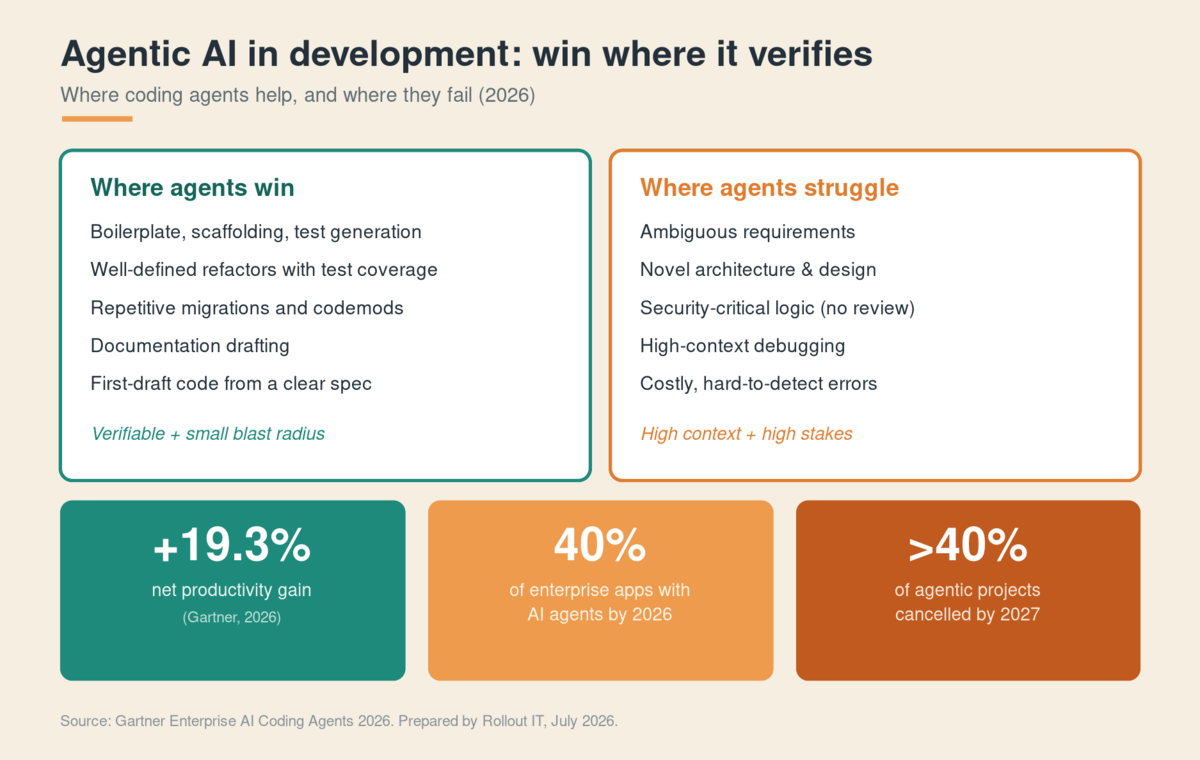
The productivity numbers back this up when the practice is disciplined. Gartner finds around 90% of engineering leaders report improvements, with a net average productivity gain near 19.3%, and developers saving roughly 3.6 hours per week; organisations running agents in production report a median of 6.4 hours saved per knowledge worker weekly. One widely cited example, TELUS, reported shipping engineering output about 30% faster with an agentic coding tool while saving more than 500,000 engineering hours. Adoption is following: Gartner expects up to 40% of enterprise applications to include task-specific AI agents by 2026, up from under 5% in 2025.
The workflow change is not “fewer engineers.” It is engineers doing more of the work that requires judgment, and less of the work that does not.
As agentic development drops the cost of building software, more teams are reopening the build-versus-buy decision; Rollout IT’s productized SaaS-replacement service, Unseated, lays out when replacing a SaaS tool with a custom build makes sense.
Where do AI coding agents help, and where do they fail?
Agents help most on well-scoped, verifiable tasks and struggle most on ambiguous, high-context, high-stakes work. The clearest wins are tasks where “correct” is easy to check and the blast radius of a mistake is small. The clearest failures are tasks where correctness depends on deep system context an agent cannot see.
| Where agents win | Where agents struggle |
|---|---|
| Boilerplate, scaffolding, test generation | Ambiguous requirements, unclear acceptance criteria |
| Well-defined refactors with good test coverage | Novel architecture and cross-cutting design decisions |
| Repetitive migrations and codemods | Security-critical logic without human review |
| Writing and improving documentation | High-context debugging across unfamiliar systems |
| First-draft implementations from a clear spec | Anything where a wrong answer is expensive and hard to detect |
This is also why so many agentic projects get cancelled. Gartner’s forecast that over 40% will be scrapped by 2027 points at escalating costs, unclear ROI, and weak risk controls, not at the technology being incapable. Teams that deploy agents against vague goals, without evaluation or guardrails, spend money and lose trust. Teams that point agents at verifiable, bounded work compound their gains.
How do you keep quality, security, and governance with autonomous agents?
You keep quality by treating agent output like any other untrusted input: it must pass review, tests, and policy checks before it ships. Autonomy without verification is the failure mode; autonomy with strong verification is the win. The practices that separate the two are not exotic, and they mirror how we build reliable AI features generally.
A few that matter most in practice:
- Human review stays mandatory. Every agent-authored change goes through code review by an engineer who owns the outcome. The agent drafts; a person is accountable.
- Tests are the safety net. Strong automated test coverage lets you accept agent work quickly and catch regressions early. Shift-left testing pays for itself: on one of our EdTech engagements, building quality in from day one cut later bug-fix costs by up to 40%.
- Scope and permissions are least-privilege. Agents get access to what a task needs and no more, with revocable credentials, exactly as you would scope a new contractor.
- Grounding and citations for anything knowledge-based. Where agents rely on internal knowledge, responses should be grounded in verified sources with citations and confidence, not generated from memory. That is the same RAG-verification discipline we apply so assistants do not hallucinate.
- Continuous monitoring and a feedback loop. Live performance monitoring, anomaly detection, and a route for issues back into the system keep quality from drifting over time.
Governance is the difference between the 19.3% gain and the cancelled project. It is also, not coincidentally, where the OpenClaw incident we analysed earlier this year is instructive: agentic tools with over-broad permissions and unverified code are a liability, not an accelerant.
What does this mean for engineering team structure?
The team shape shifts toward more senior review capacity and clearer ownership, not toward replacing developers. As agents take on first drafts, the bottleneck moves to review, integration, and judgment, so teams need people who can specify well and review critically. Junior engineers do not disappear; their work changes toward supervising, testing, and learning from agent output under senior guidance.
The uncomfortable near-term truth is that the gap between teams that use AI well and teams that use it carelessly is widening. Using an agent is easy. Governing one, so it produces trustworthy, maintainable, secure code, is a capability. That capability is what we build with clients: agents integrated into delivery with guardrails, review, and monitoring, rather than dropped in and hoped for. You can see the wider approach in our AI development work, where agentic workflows, RAG grounding, and continuous monitoring are the default, not the afterthought.
For leaders, the practical stance for 2026 is neither hype nor refusal. It is: point agents at verifiable work, keep humans accountable at the review layer, invest in tests and guardrails, and measure the result. Do that, and the productivity gains are real and durable. Skip it, and you risk joining the 40% that get cancelled.
Frequently asked questions
Will AI agents replace developers?
No. Agents shift developers toward specification, review, and integration rather than replacing them. The evidence in 2026 shows productivity gains and hours saved, but human engineers remain accountable for quality, security, and design decisions.
Are AI coding agents safe for production code?
They can be, if agent output is treated as untrusted until it passes code review, automated tests, and security checks. Least-privilege access, grounding for knowledge-based tasks, and continuous monitoring are what make production use safe.
What is the difference between AI assistants and agents?
Assistants suggest code and answer questions while a human types. Agents take a goal and carry out multi-step work: writing and editing files, running tools and tests, and iterating with limited human input. Agents offer more leverage and need more oversight.
How much faster is agentic coding?
Independent 2026 data points to a net average developer productivity gain of about 19.3% and several hours saved per developer per week, with some organisations reporting around 30% faster delivery. Results depend heavily on task type and governance.
Sources: Gartner — Enterprise AI Coding Agents 2026 Market Guide; Gartner — 40% of enterprise apps will feature task-specific AI agents by 2026; Rollout IT — AI Development; Rollout IT — Scaling EdTech platforms (Labster) case study.