
The Hidden Cost of Per-Seat SaaS (and When It Pays to Own)
Last updated: July 29, 2026.
The hidden cost of per-seat SaaS is everything that does not show on this month’s invoice: annual price rises well above inflation, a bill that grows with every hire, licences nobody uses, and no ownership of the tool or its data. Add five years of those together and the “cheap” subscription is often the expensive option.
This article breaks down where per-seat pricing quietly leaks money, how to see your real five-year number, and when it pays to own software instead of renting it.
What is per-seat SaaS pricing, and why does it cost more than it looks?
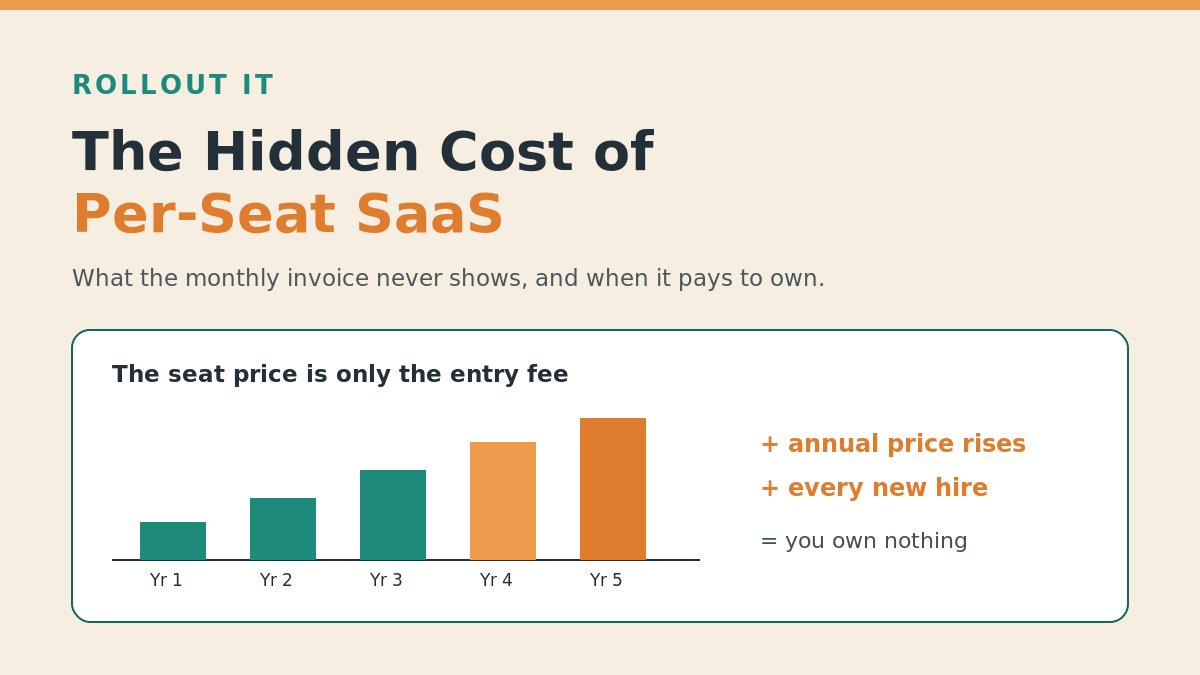
Per-seat pricing charges you per user, per month. It looks simple and predictable, which is exactly why the true cost is easy to miss. The headline seat price is only the entry fee; the real cost is what that model does to your bill over time and across your team.
Three mechanics drive it. The rate rises most years. The seat count rises as you hire. And you pay for every seat’s full feature set even when each person uses a fraction of it. None of those show up when you sign; all of them compound afterwards.
Where does per-seat SaaS quietly leak money?
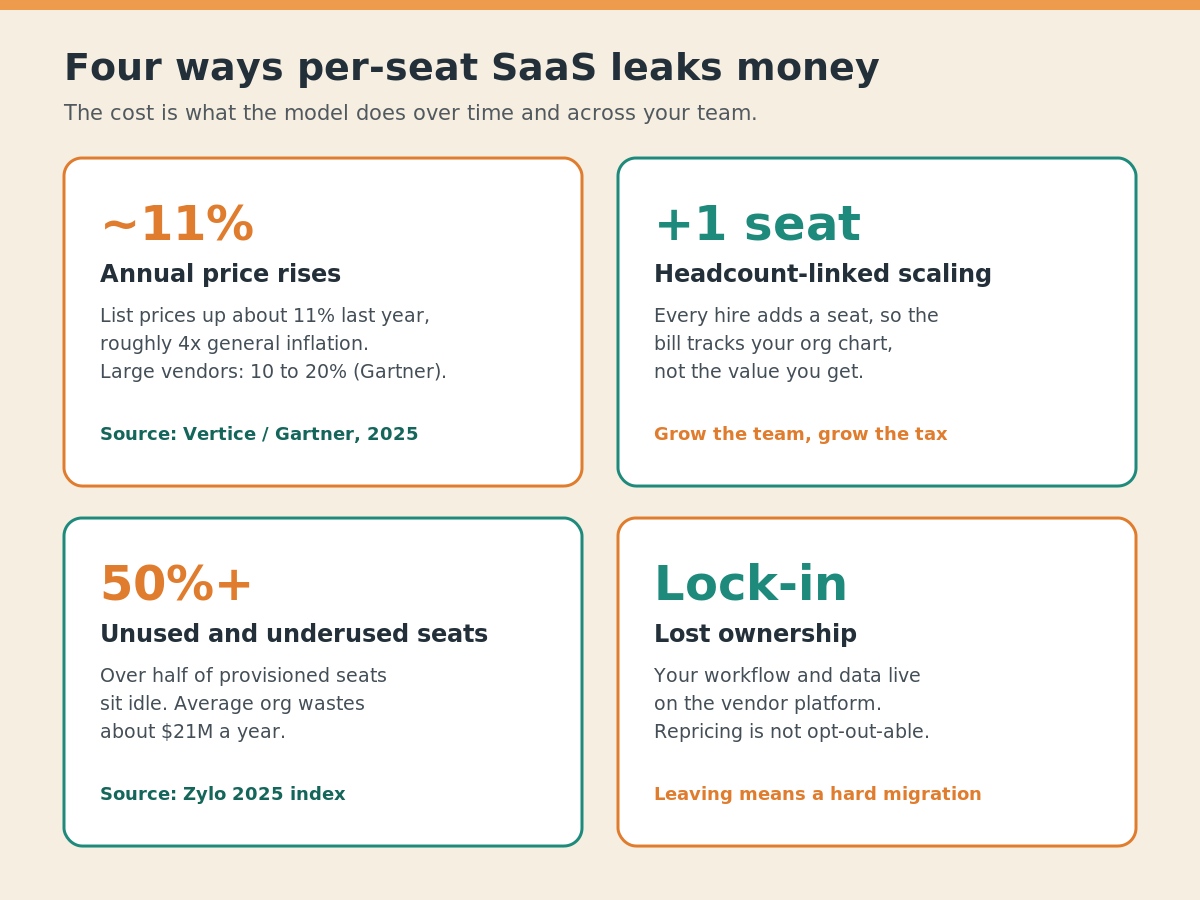
Per-seat SaaS leaks money in four predictable places:
- Annual price rises far above inflation. SaaS list prices rose about 11% in the last year, roughly four times general inflation, and Gartner analysts put large-vendor increases at 10 to 20%. In 2025, most SaaS vendor revenue growth came from charging existing customers more, not from winning new ones.
- Headcount-linked scaling. Every hire adds a seat, so your software bill tracks your org chart rather than the value you get. Grow the team and the tax grows with it.
- Unused and underused licences. Zylo’s 2025 SaaS Management Index found the average organisation wastes around $21 million a year on unused licences, with over half of provisioned seats sitting idle. Gartner puts wasted SaaS spend at roughly a quarter of the budget.
- Lock-in and lost ownership. Your workflow and your data live on the vendor’s platform. A price restructure, an acquisition, or a feature moved to a higher tier is not something you can opt out of, because leaving means a migration you have little leverage over.
What does per-seat SaaS really cost over five years?
The only fair way to judge a subscription is to project it, not to read this month’s price. A tool at a modest monthly seat rate, multiplied across a growing team and compounded by annual increases, becomes a materially larger commitment across a five-year horizon than the sticker suggests, and unlike a capital investment it leaves you owning nothing at the end.
We built a breakdown of the real five-year cost of per-seat SaaS on our Unseated project, tool by tool, plus a simple way to run your own numbers against your actual seat count and price. The pattern is consistent: the longer the horizon, the worse renting looks against owning.
When does it pay to own instead of rent?
It pays to own when a tool is core to how you work, heavily used, billed per seat, and has no natural end date. In that situation the five-year rental almost always exceeds what a custom build would cost, especially now that delivery is faster and cheaper than it used to be.
It still pays to rent when the tool is licensed infrastructure (payment rails, accounting and ERP systems), when the vendor’s network is the actual value (marketplaces, job boards), or when it carries a compliance certification you would otherwise have to build yourself. The goal is not to replace all your SaaS; it is to stop overpaying for the few tools where renting has quietly become the expensive choice.
How does owning your software work in 2026?
Owning no longer means a slow, six-figure internal build. Two shifts changed that. Agentic engineering, meaning senior engineers directing code-generation agents under real review and accountability (our approach to AI-assisted development), has cut delivery times from months to weeks. And co-funding lets several companies with the same core need share one build, each paying a fraction and then a flat annual fee with no per-seat line at all. The result is software shaped around your workflow, your data in your hands, on a licence that does not expire.
The distinction that matters is senior-led delivery versus “vibecoding.” A prototype with no tests, no architecture, and no one accountable is not ownership; it is a future outage. Done properly, owning software is an asset on your balance sheet, not a subscription on your P&L.
How Rollout IT thinks about it
We spend our days building and running production software, so we see both sides. Plenty of SaaS earns its keep, and we say so. But we also build the custom platforms that replace generic, per-seat tools when the maths turns: products like Tickerbell (an algorithmic trading platform), DropIt (a Shopify reverse-auction plugin), and Black Wolf (a full SaaS game-engine platform), each shaped around a workflow that off-the-shelf software served poorly. For Enthusiast Gaming, a NASDAQ-listed gaming network, we built the ATOM ad-management dashboard: a purpose-built system they own outright, not a per-seat subscription to generic ad tooling.
If per-seat costs are climbing faster than the value you get, the first step is not a build; it is clarity on the numbers. Our custom software development team can map which tools are worth replacing and which to keep, and our Unseated project turns that into a co-funded build when a group of companies shares the same need. Either way, the point is the same: decide on five-year ownership economics, not the comfort of a monthly line item.
Frequently asked questions
What does per-seat SaaS pricing mean?
It means paying a recurring fee for each individual user, usually monthly or annually. Costs rise as you add people and as the vendor raises rates, and you pay for each seat’s full feature set regardless of how much of it each person uses.
Why is my SaaS bill increasing every year?
Because most vendors raise prices annually, recently around 11% a year or roughly four times inflation, and because your seat count grows as you hire. In 2025 the majority of SaaS revenue growth came from price increases on existing customers rather than new ones.
How much SaaS spend is wasted on average?
Studies put it high: Gartner estimates about a quarter of SaaS spend goes to unused entitlements, and Zylo’s 2025 index found more than half of licences unused and around $21 million wasted per organisation each year.
Is it cheaper to build than to keep paying per seat?
For heavily used, per-seat tools with no end date, owning is often cheaper across five years, particularly with faster AI-assisted delivery and co-funding. For licensed infrastructure, network-based platforms, or certified-compliance tools, keep renting.
Sources: Rollout IT: Custom Development; Rollout IT: AI Development; Rollout IT: Tickerbell; Rollout IT: DropIt; Rollout IT: Black Wolf SaaS game engine; Rollout IT: Enthusiast Gaming ATOM dashboard; Unseated: SaaS Tax (5-year cost); Unseated savings calculator; Zylo 2025 SaaS Management Index; Vertice SaaS Inflation Index.