
How to Become an AI-Native Company in 2026: A Practical Roadmap
Becoming an AI-native company means redesigning your operating model so AI sits inside the work itself, not bolted on beside it. In practice that is a three-part shift: rebuild core workflows around AI, put a data and feedback loop at the centre, and let small senior teams supervise AI instead of scaling headcount. This guide explains what “AI-native” actually means and gives you a step-by-step roadmap to get there.
What does “AI-native” actually mean (vs. AI-first and AI-enabled)?
An AI-native company is one whose product and operations are designed around AI from the ground up: remove the intelligence layer and the business no longer works in any meaningful form. That is the practical test. It is different from the two weaker levels most companies actually sit at today.
The three levels are easy to confuse, so it helps to name them:
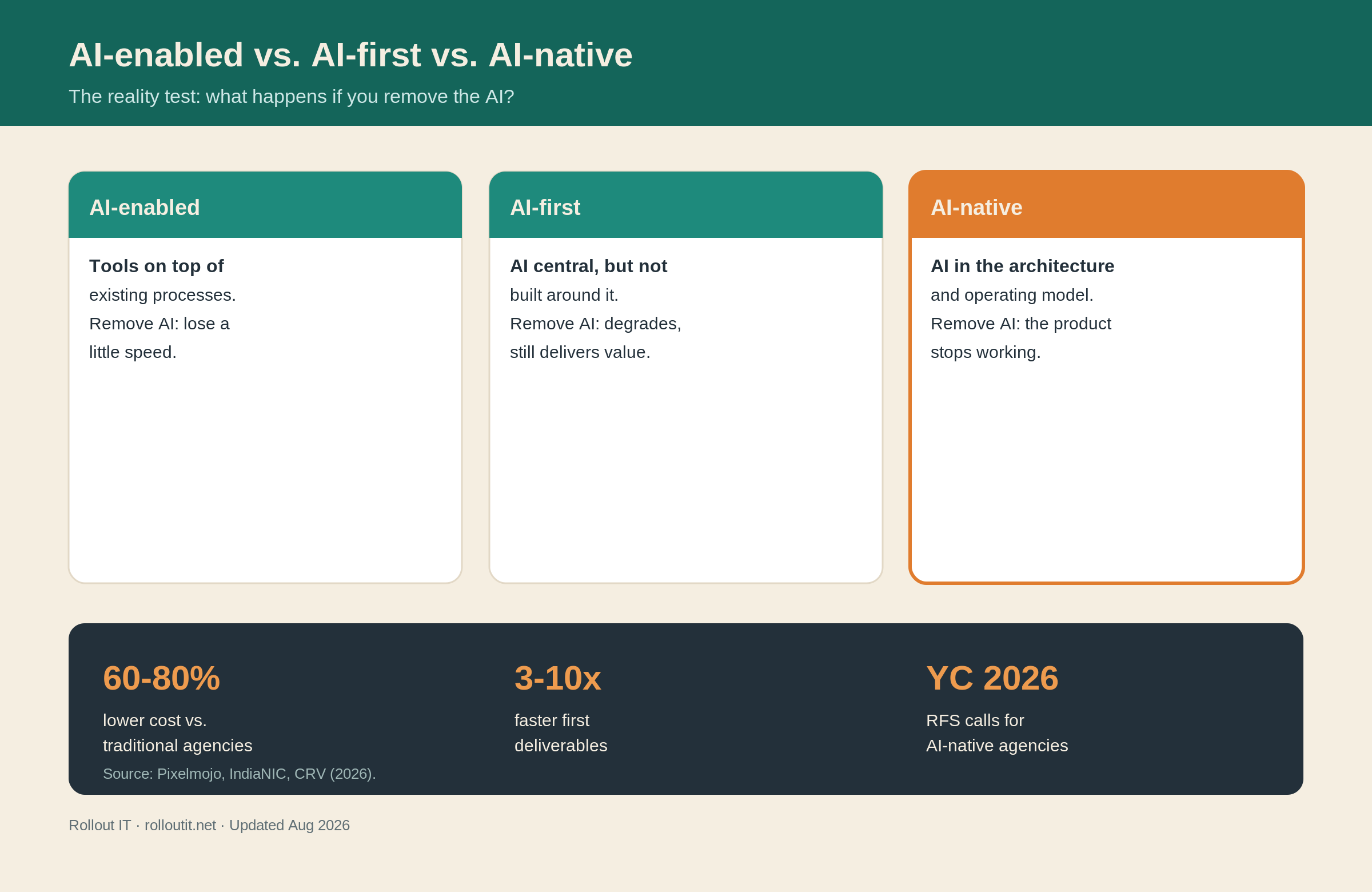
| Level | What it means | Reality test |
|---|---|---|
| AI-enabled | AI tools are used by some teams, on top of existing processes | Remove AI and nothing breaks; you lose a little speed |
| AI-first | AI is central to the product and decisions, but the company was not built around it | Remove AI and the product degrades but still delivers some value |
| AI-native | AI is part of the architecture and the operating model itself | Remove AI and the product or service stops working |
Most organisations describe themselves as AI-first when they are really AI-enabled. Being honest about your starting level is the first step, because the roadmap below is about moving up one level at a time, not skipping to the end.
Why is 2026 the year companies are moving from experiments to AI-native?
The shift is happening now because the industry has moved past experimentation into execution: leaders are being measured on whether AI actually changes how work moves through the business, not on how many pilots they ran. The evidence is strongest in services. AI-native agencies report first deliverables in one to two weeks versus eight to twelve at a traditional agency, cost savings of 60 to 80 percent against traditional rates, and output of 50 to 150+ variants a month versus 5 to 15 from a typical retainer (Pixelmojo, IndiaNIC).
The signal is not only anecdotal. Y Combinator’s Spring 2026 Request for Startups explicitly calls for founders to build AI-native agencies, arguing the traditional, headcount-dependent model is structurally broken (CRV). When the labour model inverts like this, small senior teams supervising AI that does a material share of the work, output scales without scaling headcount, and that changes the economics of an entire company.
How do you become an AI-native company? A practical roadmap
You become AI-native by moving up one level at a time: pick a high-friction workflow, rebuild it around AI, instrument the data and feedback loop, then repeat across the business while your operating model and team structure catch up. Here is the sequence we use with clients.
1. Diagnose your real level. Map three to five core workflows and apply the reality test above to each. Be specific about where AI is genuinely load-bearing versus where it is a convenience.
2. Pick one high-friction, high-volume process. Choose a workflow that is repetitive, measurable, and painful. Establish a baseline: time spent, cost, error rate, cycle time. Without a baseline you cannot prove ROI.
3. Rebuild the workflow around AI, not beside it. Redesign the process assuming AI does the repeatable work and a human owns direction and quality control. Ask the AI-native question: if AI can do large parts of this, what should the process look like now?
4. Put a data and feedback loop at the centre. Design the system to improve with every use. When a person corrects an AI output, that correction should flow back and make the next output better. This compounding loop is what separates AI-native systems from static automations.
5. Add governance and measurement before you scale. Define access controls, review steps, and an audit trail. Track time reclaimed and adoption so leadership can see the ROI and the risk in the same view.
6. Reshape the operating model and team. As AI takes the repeatable work, roles shift from executor to supervisor and reviewer. Plan the change management: this is where most transformations stall.
7. Repeat across the next workflow. AI-native is reached workflow by workflow, not in one big-bang programme. Each cycle should be measurable in weeks, not quarters.
What does an AI-native architecture look like?
An AI-native architecture has three layers: an intelligence layer, an automation and workflow layer, and an interface and data layer that captures the feedback that makes the system smarter over time. In 2026 the intelligence layer usually means accessing foundation models through APIs rather than training your own, so the differentiation is not the model, it is your data, your workflows, and your feedback loops.
That is the strategic point most teams miss. The foundation model is a commodity everyone can rent. The durable advantage is the proprietary data you capture, the workflows you rebuild around it, and the learning loops that make your system compound in value while a competitor’s stays flat.
AI-native vs. traditional: what actually differs?
The core difference is the unit of value. A traditional company’s unit of value is human time, billable hours, retainers, and large teams of junior executors under management layers. An AI-native company’s unit of value is a system where autonomous components handle the repeatable work and a small senior team provides strategy, judgement, and client relationships.
That does not make traditional models obsolete. AI-native wins decisively on speed, cost, and output volume; traditional strengths like senior human judgement, brand depth, and strategy still matter, and in an AI-native model they become the scarce, high-value human contribution rather than the bottleneck.
What are the common failure modes, and how do you avoid them?
The most common failure is treating AI-native as a tooling project instead of an operating-model change: teams buy tools, run pilots, and never rewire how work actually flows. Governance gaps are the second failure mode; Gartner has warned that a large share of agentic AI projects will be scrapped by 2027, often because they were launched without clear ownership, measurement, or risk controls.
Avoid both by doing what the roadmap above front-loads: start from a workflow and a baseline, not a tool; assign a human owner to every AI-driven process; and build governance and measurement in from the first cycle rather than after something goes wrong. AI-native is a change-management discipline as much as an engineering one.
How Rollout IT helps companies go AI-native
At Rollout IT we approach AI-native transformation as an engineering-led delivery problem paired with executive-level clarity, with the goal of turning scattered AI experiments into working processes and measurable ROI in weeks, not years. Across 10+ years and 50+ delivered projects, the pattern we see holds: the companies that succeed start from one high-friction workflow, instrument it, and let the operating model change follow the proof, exactly the sequence in the roadmap above.
Our AI Transformation offer is built for this. The AI Pioneer Program helps managers ship one to three automated workflows with a measured time-saved baseline, and the AI Strategist Accelerator gives leadership a prioritised use-case portfolio and a 12-month roadmap with ROI and governance built in. Delivery discipline comes from our senior engineering teams; strategy and governance come through our ChangeAI partnership, so the transformation is measurable and safe, not a science experiment.
Frequently asked questions
What is an AI-native company?
An AI-native company is one whose product and operating model are designed around AI from the ground up: if you removed the AI, the business would no longer function. It is a step beyond AI-first (AI is central but the company was not built around it) and AI-enabled (AI tools sit on top of existing processes).
What is the difference between AI-native and AI-first?
AI-first means AI is central to the product and decisions, but the company was not architected around it, so removing AI degrades value without stopping it. AI-native means AI is part of the architecture and operating model, so removing it breaks the product entirely.
How long does it take to become AI-native?
There is no single timeline, because AI-native is reached workflow by workflow rather than in one programme. A single high-friction process can be rebuilt and measured in weeks; becoming AI-native across the business is a staged journey where each cycle should produce measurable ROI.
Do you need to train your own models to be AI-native?
No. In 2026 most AI-native companies access foundation models through APIs rather than training their own. The durable advantage is not the model but your proprietary data, the workflows you rebuild around it, and the feedback loops that make your system improve with every use.