

How to Choose an IT Staff Augmentation Company in 2026: A Buyer’s Checklist
To choose a staff augmentation company, score each vendor on five things: engineer vetting quality, retention rate, contract flexibility, transparent pricing, and a verifiable track record. The best fit is the firm that lets senior people start in weeks, bills month to month, and puts its own risk on the line. This guide turns those five criteria into a checklist you can run against any shortlist.
Below we define what IT staff augmentation is and when it beats hiring, walk through the checklist, compare augmentation with outsourcing and a dedicated team, and show the contract terms that actually protect you in 2026.
What is IT staff augmentation, and when does it make sense?
IT staff augmentation is a sourcing model where a provider adds pre-vetted, external engineers to your existing team, on a flexible contract, under your day-to-day direction. You keep product ownership and management; the partner handles sourcing, contracts, and ongoing performance support in the background. It is closer to extending your own team than to handing work off.
It makes sense when you need specific senior skills quickly, for a defined period, without a permanent headcount commitment. Typical triggers are a slipping roadmap because one skill is missing, a demand spike like a migration or launch with a clear end date, or a need to test a person before a full-time offer. The 2026 market is moving toward skills-based, outcome-focused engagements rather than pure time-and-materials staffing, which rewards buyers who scope the actual result they want, not just a warm seat.
How do you choose the right company? (the 5-point checklist)
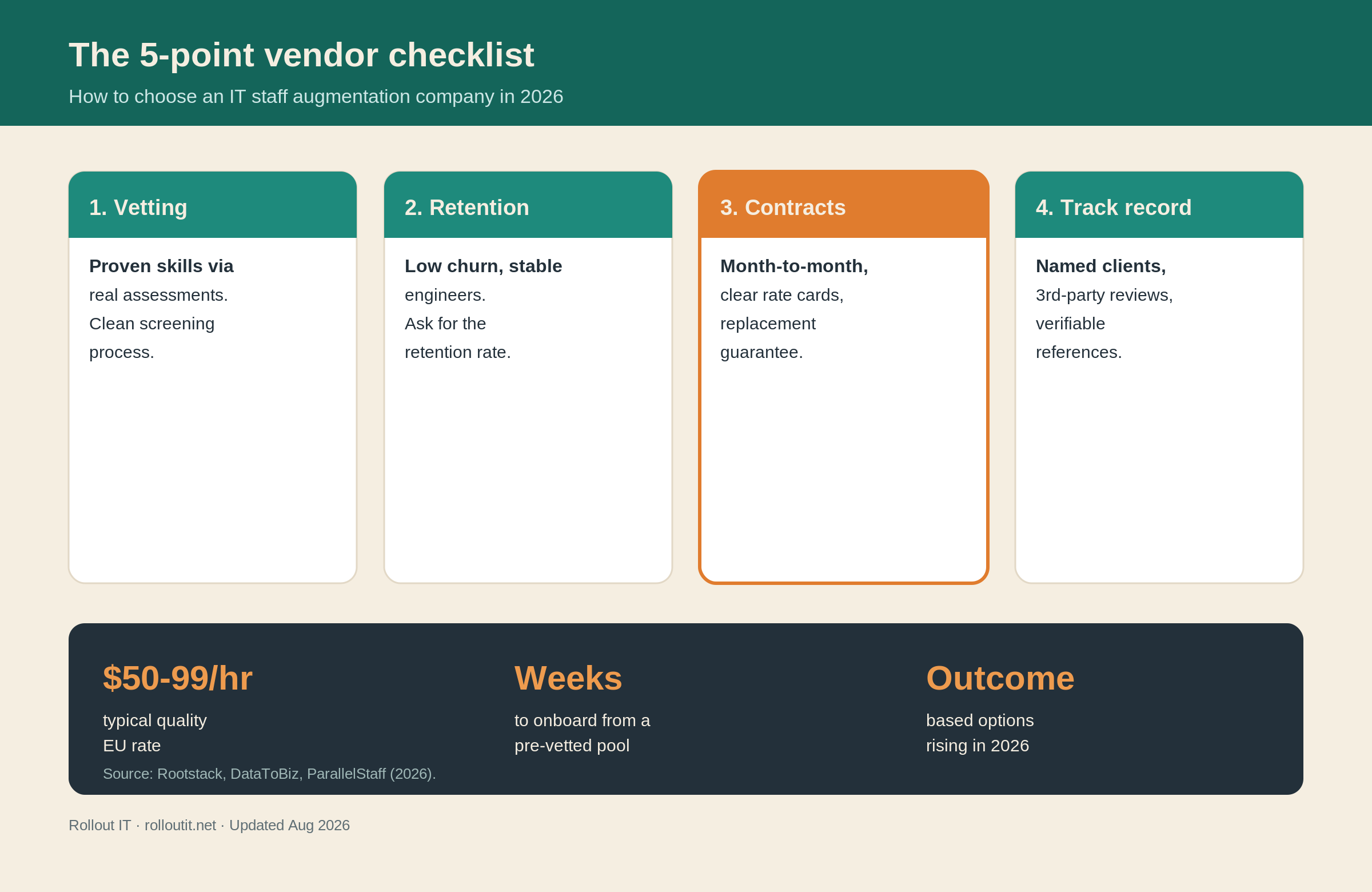
Choose the company that scores highest across five criteria: vetting, retention, contract flexibility, pricing transparency, and proof. Weak vendors look fine on a website and fall apart on two of these; strong ones can evidence all five on a first call. Run this list against every name on your shortlist.
1. Engineer vetting quality. Ask how candidates are screened before you ever meet them. You want a multi-stage process: CV and experience review, a role-specific technical assessment, and soft-skill and culture-fit checks, so you only interview high-potential matches. In our delivery work, this front-loaded screening is what keeps client interview-to-hire ratios high and avoids the “three no-shows before one fit” pattern.
2. Retention rate. High engineer churn on the vendor’s side becomes your onboarding tax. Ask what share of augmented engineers stay on an engagement for its planned duration, and how replacements are handled when someone does leave. Stable teams compound context; rotating ones reset it every quarter.
3. Contract flexibility. Look for month-to-month billing and no lock-in beyond a short notice period. The point of augmentation is to scale up and down with the roadmap, so a 12-month minimum defeats the purpose. Flexibility is a feature, not a discount you have to negotiate for.
4. Transparent pricing. You want clear rate cards by seniority and role, agreed upfront, with no hidden onboarding fees and no surprise charges for ramp-up or early offboarding. If a quote cannot be broken down by who does the work and at what rate, that is a signal.
5. Verifiable track record. Ask for named clients, third-party reviews, and evidence the company is a stable legal entity. Independent review platforms, audited financials, and relevant industry references (for example regulated FinTech work) tell you the firm will still be there mid-project.
Staff augmentation vs outsourcing vs a dedicated team
Staff augmentation gives you the most control: individual engineers join your team and work under your direction. Outsourcing hands an entire project to a third party to run end to end. A dedicated (managed) team sits between the two: a partner owns a workstream but stays aligned to your roadmap. Most scaling companies use a blend, so the question is which model fits which need.
| Dimension | Staff augmentation | Dedicated / managed team | Full outsourcing |
|---|---|---|---|
| Who manages the work | You, day to day | Shared: partner lead + your roadmap | The vendor, end to end |
| Best for | A missing senior skill, now | A whole feature or platform to own | A defined project outside your core |
| Control over delivery | High | Medium | Low |
| Speed to start | Weeks | Weeks to a month | Slower (scoping heavy) |
| Flexibility to scale | High (per person) | Medium | Low (contract-bound) |
| Pricing model | Time & materials or outcome-based | Team rate, often monthly | Fixed-price or milestone |
The practical rule: augmentation when you need specific hands inside your team fast, a dedicated team when you want someone to own an outcome, outsourcing when the work sits outside your core and can be fully specified. If control and integration matter, augmentation wins.
How should you vet engineers and check retention?
Vet on evidence, not on CVs alone: insist on a technical assessment tied to your actual stack, and treat the vendor’s own screening as the first filter, not the last. A serious partner sources, screens, and technically evaluates each candidate through an internal specialist before presenting anyone, so your interview is a confirmation step, not a lottery. Ask to see the screening stages in writing.
On retention, ask two concrete questions. First, what proportion of engineers complete their planned engagement without the vendor rotating them off? Second, when a replacement is genuinely needed, how fast can a like-for-like profile start, and who absorbs the ramp-up cost? A confident firm answers both without hedging, because it tracks these numbers internally. In our experience, retention is the single most under-asked question in buyer calls, and the one that predicts the most pain later.
A quick tell for AI-fluency in 2026: ask how candidates use AI tooling in their daily workflow, from code assistants to automated testing. You are not looking for hype, you are looking for engineers who ship faster because the tools are part of how they work.
What contract terms protect you? (month-to-month, rate cards, replacement guarantee)
Three terms do most of the protecting: month-to-month billing, a clear rate card by seniority, and a replacement guarantee. Together they mean you can leave if it is not working, you always know what you are paying and why, and a poor-fit engineer is the vendor’s problem to fix, not yours to absorb.
- Month-to-month billing. Pay for actual time worked, with a short notice period, so you can scale down when the roadmap changes. Avoid long minimum terms dressed up as “commitment discounts.”
- Rate cards by seniority. Rates defined upfront per role and experience level, contract-based, with no hidden onboarding fees and no charge for early offboarding or ramp-up. Predictable pricing is a clarity signal, not a nice-to-have.
- Risk-reversal / replacement guarantee. If an engineer is not the right fit, the vendor replaces them at its cost within a defined window. This puts the firm’s own risk on the line and is the clearest sign it stands behind its vetting.
What does it cost, and how is it priced in 2026?
Pricing is usually time and materials: an hourly, daily, or monthly rate set by the engineer’s seniority, role, and tech stack, agreed upfront and billed for actual time worked. For context, quality European providers commonly sit in the region of $50 to $99 per hour, a meaningful saving versus North American and Western-European in-house rates for comparable seniority, without the offshore trade-offs on time zone and communication.
The 2026 shift worth planning for is the move from pure time-and-materials toward outcome-based engagement, where part of the arrangement is tied to a defined result rather than only hours. Faster onboarding and AI-fluent engineers are pushing the same way: you are increasingly buying delivered outcomes, not just staffed seats. When you compare quotes, compare like for like: seniority, notice period, replacement terms, and what is included, not just the headline rate.
How Rollout IT augments engineering teams (first-hand)
Rollout IT provides pre-vetted, EU-based engineers who integrate into your team on a time-and-materials basis, with a Try-and-Hire path when you want to convert someone to a permanent role. With 10+ years in business, 50+ delivered projects, and 30+ experts, our model is built on the “Humans first, always” principle: augmented engineers act as a true extension of your in-house team, under your direction, with our support running in the background.
We operate from Hungary as Runios IT Ltd., hold a Hungarian workforce-leasing licence, and publish audited financials, so procurement and due-diligence teams can verify a stable, low-risk partner. Our FinTech clients include Erste Bank, MBH Bank, ixlayer, and Tickerbell, the kind of security-critical, regulated work that only passes when vetting and retention are real. For a sector-specific view, see our guide on staff augmentation in FinTech and our staff augmentation services. For teams weighing a European delivery base, our guide to nearshoring to Central Europe covers the wider trade-offs.
Frequently asked questions
What is the difference between staff augmentation and outsourcing?
Staff augmentation adds specific engineers to your existing team, working under your direction on your stack. Outsourcing hands an entire project to a third party to manage end to end. Augmentation gives you more control and flexibility; outsourcing gives you less involvement but also less oversight.
How do I evaluate a staff augmentation company?
Score each vendor on five criteria: engineer vetting quality, retention rate, contract flexibility, transparent pricing, and a verifiable track record. Ask for the written screening process, named clients, third-party reviews, and a replacement guarantee. The strongest firms can evidence all five on the first call.
How much does IT staff augmentation cost in 2026?
Most engagements are priced on time and materials, with the rate set by seniority, role, and tech stack. Quality European providers commonly fall in the $50 to $99 per hour range. In 2026, expect more outcome-based options tied to a defined result rather than hours alone.
How fast can augmented engineers start?
When a provider maintains a pre-vetted talent pool, senior engineers can typically onboard in weeks rather than the months a permanent hire takes. Speed depends on how well the role brief is defined and how quickly access and tooling are set up.
Should I choose a month-to-month contract?
Yes, where possible. Month-to-month billing with a short notice period lets you scale with your roadmap and leave if the fit is wrong. Pair it with clear rate cards and a replacement guarantee so pricing stays predictable and poor-fit risk sits with the vendor.
Can I hire an augmented engineer permanently later?
Often, yes, through a Try-and-Hire path. You engage the person on time and materials during a trial period, then convert them to a direct hire if it works out. It is a low-risk way to test fit before making a permanent commitment.