
Machine Learning in Ecommerce: Recommendation Systems That Actually Lift Revenue (2026)
Machine learning in ecommerce is the use of models that learn from customer behaviour to predict what each shopper wants next, most visibly in product recommendations. It matters because recommendation engines now drive roughly 26 to 31 percent of ecommerce revenue on average, and Amazon attributes about 35 percent of its revenue to recommendations. This guide explains how the systems work, the results they drive, and whether to build or buy your own engine.
How is machine learning used in ecommerce?
Machine learning is used across the ecommerce funnel wherever a prediction beats a fixed rule: recommendations, search ranking, dynamic pricing, demand forecasting, and fraud detection. The single highest-leverage use case, and the one most teams start with, is personalized product recommendation in e-commerce, because it touches revenue directly on the pages shoppers already visit.
The market reflects that priority. The retail machine-learning market is on track to reach around 20 billion dollars by 2026, and about 73 percent of retailers now use machine learning for personalization (Hello Retail). The common thread across machine learning use cases in ecommerce is the same: a model watches what customers do, learns the patterns, and makes a decision per shopper, per session, at a scale no manual merchandising team could match.
How do recommendation systems work?
A recommendation engine ranks products for a specific shopper by learning from behavioural data, either from patterns across many users, from the attributes of the items themselves, or from a blend of both. There are three core approaches, and knowing the difference tells you what data you need and where each one breaks.
Collaborative filtering
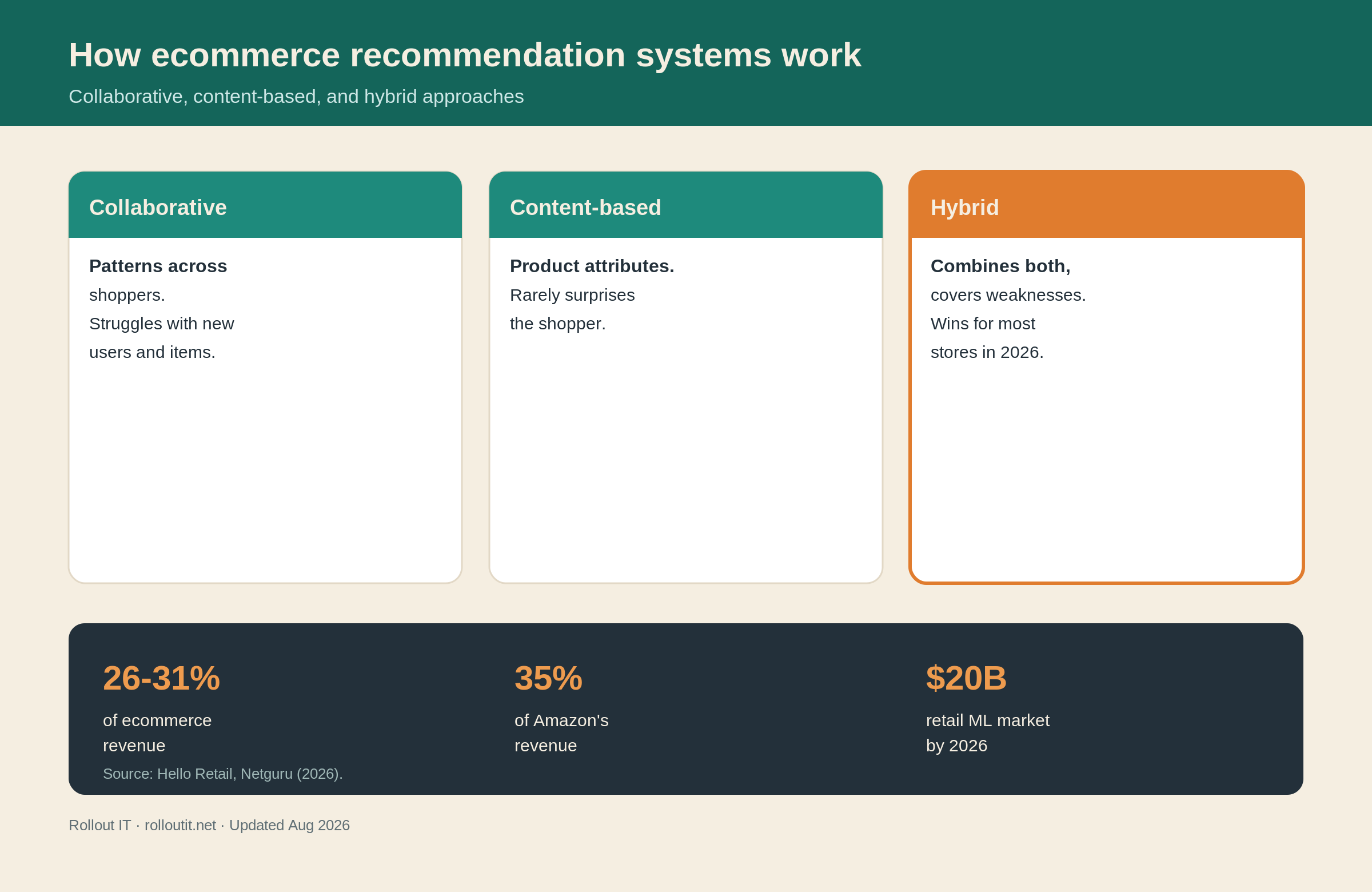
Collaborative filtering recommends items by finding shoppers who behaved like you and surfacing what they bought or viewed. It powers the classic “customers who bought this also bought” pattern. It is powerful because it needs no knowledge of the product itself, only behaviour, but it struggles with new users and new products that have no interaction history yet, the well-known cold-start problem.
Content-based filtering
Content-based filtering recommends items similar to ones a shopper already liked, using product attributes such as category, brand, price band, colour, or text description. It handles new products well because it reads their attributes directly, and it works even when a user is new to the site. Its weakness is the opposite of collaborative filtering: it tends to keep recommending more of the same and rarely surprises the shopper with something adjacent.
Hybrid recommenders
Hybrid recommenders combine collaborative and content-based signals, often with additional context like session behaviour, time, and inventory, to cover each method’s blind spots. This is what most serious machine learning product recommendation systems use in production in 2026. A hybrid model can lean on product attributes when behavioural data is thin, then shift to collaborative signals as interaction history builds, which is why hybrids are the default choice for AI personalization ecommerce work.
What business results do ML recommendations drive?
ML recommendations drive revenue by raising conversion, average order value, and repeat purchase rates, which is why recommendations account for roughly 26 to 31 percent of ecommerce revenue on average. Amazon is the reference point: it attributes about 35 percent of its revenue to its recommendation engine (Netguru).
The gap between potential and reality is the real story for most teams. While about 73 percent of retailers use machine learning for personalization, only around 29 percent of ecommerce teams have fully implemented AI workflows; most sit in pilot or partial deployment (Hello Retail). In other words, adoption is broad but shallow, and the revenue upside is concentrated in the minority who move recommendations from a widget into the core of the shopping experience.
Build vs buy: build a recommendation engine or use a platform?
Build or buy comes down to whether recommendations are a differentiating part of your product or a feature you can rent. Buy when a platform recommender is good enough and speed matters; build (or co-fund a build) when your catalogue, data, or business model makes a generic engine a poor fit. The matrix below is the framework we use with clients.
| Decision factor | Lean BUY (platform / SaaS recommender) | Lean BUILD (custom engine) |
|---|---|---|
| Catalogue | Standard retail catalogue, common product types | Unusual items, complex variants, or B2B configurations off-the-shelf models handle poorly |
| Data | Limited first-party data; you benefit from the vendor’s shared signals | Rich proprietary behavioural data that is itself a competitive asset |
| Differentiation | Recommendations are table stakes, not your edge | Discovery and personalization are core to how you win |
| Time to value | Need results in weeks, small team | Can invest a delivery cycle for a system you own |
| Cost model | Predictable subscription, fine at your scale | Per-order or revenue-share pricing that compounds painfully at scale |
| Control | Comfortable with the vendor’s roadmap and data policies | Need full control of logic, ranking, privacy, and the exit |
The honest test is the same one we apply in our build vs buy framework: buy the recommendation logic that runs on someone else’s commodity model, build the engine that encodes a competitive advantage you own. Many teams land in the middle, starting on a platform to validate the lift, then building once recommendations prove material to revenue and the SaaS bill starts scaling with orders.
What data, infrastructure, and team do you need?
You need three things to run ML recommendations in production: clean behavioural and catalogue data, infrastructure to serve predictions in real time, and a small team that owns the model after launch. Underinvesting in any one of the three is the most common reason a promising pilot never reaches customers.
- Data. Event tracking (views, add-to-cart, purchase), a well-structured product catalogue with usable attributes, and enough interaction volume for patterns to emerge. Data quality beats model sophistication almost every time.
- Infrastructure. A pipeline to collect and process events, a place to train and store models, and a low-latency serving layer so recommendations render without slowing the page. In 2026 most teams access foundation models and managed ML services through APIs rather than building everything from scratch, so the differentiator is your data and your workflows, not raw model code.
- Team. Recommenders are not a set-and-forget install. They need monitoring, retraining as the catalogue and behaviour shift, and someone accountable for ranking quality and business KPIs. A model that is not maintained quietly decays.
This is the kind of work our custom machine learning delivery is built around: models tied to a client KPI, instrumented, and improved as the data changes rather than shipped once and forgotten.
How do you avoid common pitfalls (cold start, bias, privacy)?
The three pitfalls that sink ML recommendations are cold start, feedback-loop bias, and privacy missteps, and each has a known mitigation. Plan for all three before launch, because retrofitting fixes after a model is live in front of customers is far more expensive.
- Cold start. New shoppers and new products have no history. Bridge the gap with content-based signals, popularity fallbacks, and lightweight onboarding prompts until enough behaviour accrues for collaborative methods to work.
- Bias and feedback loops. A recommender that only promotes what already sells will bury the long tail and narrow discovery over time. Counter it by injecting exploration, monitoring catalogue coverage, and testing against business metrics, not just click-through.
- Privacy and compliance. Personalization runs on personal data, so GDPR and the EU AI Act set real constraints for teams selling into the EU and UK. Build in consent handling, data minimisation, and transparency from day one rather than bolting them on after a review.
How Rollout IT builds ML-driven ecommerce features (first-hand)
At Rollout IT, AI development is a core offer, and custom machine learning for prediction and classification is one of the models we ship most often, always tied to a specific client KPI and monitored after launch. Across 10+ years, 50+ delivered projects, and 30+ in-house experts split across the EU (Hungary) and the US, the pattern that holds for recommenders is the one this guide describes: start from clean data and a measurable baseline, choose the simplest approach that fits the catalogue, then harden it against cold start, bias, and privacy before scaling.
Our commerce and product work spans that spectrum first-hand. We built DropIt, a Shopify reverse-auction plugin, worked on discovery for the Showcase marketplace, and delivered generative-AI product experiences with Reelu. One recurring lesson: the durable advantage is rarely the model itself, which is increasingly a commodity, but the proprietary data you capture and the feedback loop that makes each recommendation better than the last. That is also why we push clients toward the honest build-vs-buy question early, so they invest in owning the part that actually differentiates them.
Frequently asked questions
What is machine learning in ecommerce?
Machine learning in ecommerce is the use of models that learn from customer behaviour and product data to make predictions, most commonly which products to recommend to each shopper. It also powers search ranking, dynamic pricing, demand forecasting, and fraud detection, but recommendations are where it touches revenue most directly.
How much revenue do product recommendations drive?
Recommendations drive roughly 26 to 31 percent of ecommerce revenue on average, and Amazon attributes about 35 percent of its revenue to its recommendation engine. The upside is concentrated in teams that move recommendations into the core shopping experience rather than treating them as a side widget.
What is the best recommendation algorithm for ecommerce?
For most stores in 2026 a hybrid recommender wins, because it combines collaborative filtering (patterns across shoppers) with content-based filtering (product attributes) and covers each method’s weaknesses. Pure collaborative filtering struggles with new users and products; pure content-based filtering rarely surprises the shopper.
Should we build our own recommendation engine or use a platform?
Buy when recommendations are a standard feature and you need results fast; build when your catalogue, proprietary data, or business model make a generic engine a poor fit, or when per-order SaaS pricing compounds at your scale. Many teams start on a platform to prove the lift, then build once it is clearly material to revenue.
What is the cold-start problem?
Cold start is when a recommender has no behavioural history for a new shopper or a new product, so it cannot yet find similar users or items. The usual fixes are content-based signals, popularity fallbacks, and light onboarding prompts until enough interaction data accumulates.