
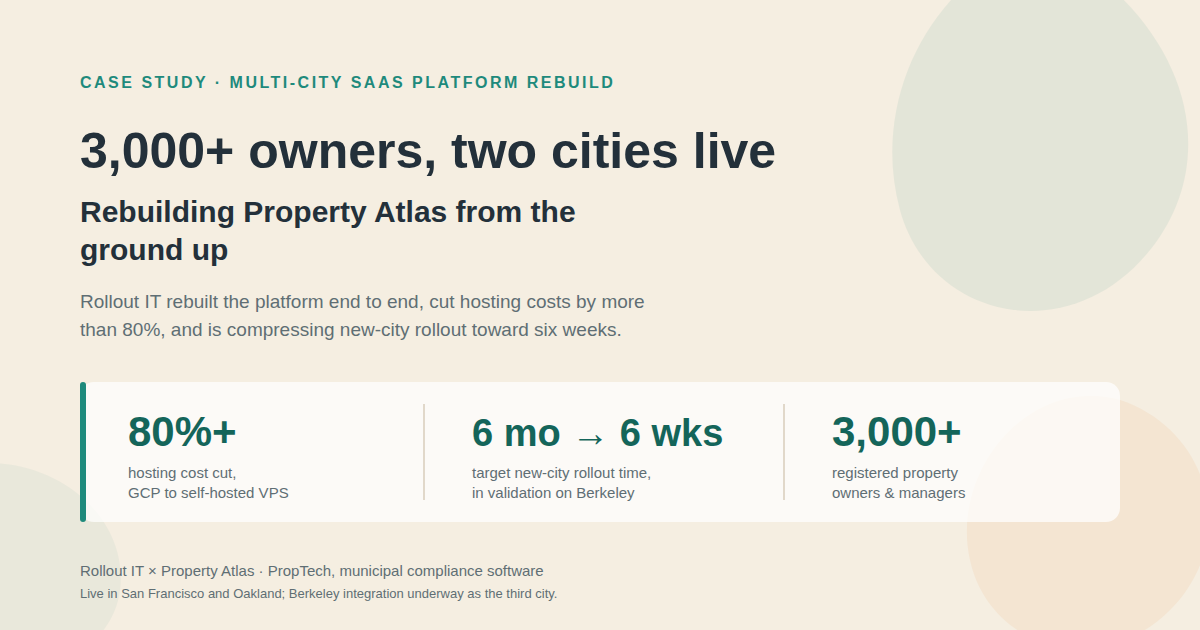
3,000+ property owners, two cities live: rebuilding Property Atlas from the ground up
Property Atlas helps property owners and portfolio managers in San Francisco and Oakland stay ahead of city code violations before they turn into fines. Since 2023, Rollout IT has rebuilt the platform from the ground up, cut hosting costs by more than 80%, and is now compressing new-city rollout time from six months toward six weeks, with a third city underway.
Carrying a legacy platform that needs to scale into new markets? Talk to us
Snapshot
| Field | Detail |
|---|---|
| Client | Property Atlas |
| Industry | PropTech / municipal compliance software |
| Region | San Francisco Bay Area, USA |
| Company stage | Small, revenue-generating proptech company, expanding city by city |
| What we built | Full frontend and backend rebuild, the Alerting System compliance module, a generic multi-city data-integration framework, admin data-correction tools, API access and team portfolio features |
| Tech stack | Node.js/TypeScript backend, Rust permit-scraper microservice, React/TypeScript frontend, custom type-safe RPC layer, Postgres partitioned per city, Docker Swarm on a self-hosted VPS, Terraform, Firebase Auth |
| Headline KPIs | 3,000+ registered property owners and managers – hosting costs down from ~$1,000 to under $200 a month – 2 cities live with a 3rd underway |
The challenge
Property Atlas came to Rollout IT in 2023 with a working app already live in San Francisco, built by a previous team. It had real gaps and was riddled with security issues typical of early-stage, under-resourced development. Rollout IT was brought in to fix it, but the brief quickly grew: a full frontend redesign, delivered against a tight deadline, plus a brand-new feature, the Alerting System, which would become the product’s core.
The bigger obstacle only appeared once the rebuild was underway. City compliance data has no shared standard: property identifiers, address formats and permit datasets are structured completely differently from one city to the next, and the public datasets themselves are often just raw spreadsheet exports with duplicate IDs and inconsistent formatting. Code written for San Francisco could not simply be pointed at a second city.
The solution
Rollout IT rewrote Property Atlas end to end. Only the Firebase-based login was kept from the original codebase; everything else, frontend and backend, was rebuilt. The centerpiece is the Alerting System: it tracks violations, compliance programs and permit updates for every registered property, keeping owners in sync with many gigabytes of unreliable, unnormalized public data without them ever having to read it themselves. Owners can fix issues before an inspector ever needs to visit, avoiding the fines the city issues when a violation goes unresolved.
A free tier for up to three properties keeps the tool useful to individual homeowners, while organizations tracking more properties move onto paid plans, which is also Property Atlas’s core revenue model. On top of the core product, the team added portfolio features for teams managing many buildings, configurable per-person notification preferences, and a dedicated API integration for the platform’s largest enterprise accounts.
Under the hood
Expanding beyond San Francisco meant solving the data-chaos problem generically. A single city feed can hide several record types, one record can require pieces from two separate feeds, and some fields do not exist in the raw data and have to be computed. The team formalized this into an internal data-fetching framework: a feature declares what data it needs and what depends on what, and the framework resolves the optimal set of fetches across those inconsistent, sharded datasets automatically.
The backend is a TypeScript monolith on Node.js, with one exception: the permit scraper runs as its own Rust service, since scraping government data at city scale is memory-heavy. Frontend and backend share a custom, type-safe RPC layer, so a breaking backend change fails the frontend build instead of production. Infrastructure moved from Google Cloud to a self-hosted, Terraform-provisioned Docker Swarm VPS.
A dedicated sync service ingests each city’s open-government datasets through a freshness pipeline, and every changeset is validated before it is applied: a destructive change is rejected and logged, and a dataset that keeps failing quarantines itself for human review instead of corrupting production data.
See how we rebuild legacy platforms without a rewrite freeze. Talk to us about custom development
Results
- Hosting costs cut by more than 80%: from roughly $1,000/month on Google Cloud to under $200/month on a self-hosted, Docker Swarm-based VPS.
- Scaled from one city to a multi-city platform: live in San Francisco and Oakland, with Berkeley integration underway.
- 3,000+ property owners and managers have registered, up from zero at the start of the engagement.
- Tracked portfolios grew about 25% in seven months, from roughly 1,080 properties in January 2026 to about 1,350 by July 2026.
| Metric | Before | After | Timeframe |
|---|---|---|---|
| Monthly hosting cost | ~$1,000 (Google Cloud) | <$200 (self-hosted VPS) | Since migration |
| Cities supported | 1 (San Francisco) | 2 live, 1 in progress | 2023 to 2026 |
| New-city integration time | ~6 months | ~6 weeks (in validation) | 2026 |
| Registered owners/managers | 0 | 3,000+ | Since 2023 |
| Properties tracked | ~1,080 | ~1,350 (+25%) | Jan-Jul 2026 |
Property Atlas has sent tens of thousands of violation-related email alerts to date, and close to 20 of its active customer organizations already track a minimum of three properties of their own. Figures come from Property Atlas’s own usage records and exclude internal test accounts.
Where AI made the difference
Rollout IT’s engineer on the account uses agentic coding tools, running AI coding agents in isolated remote workspaces, to speed up feature delivery across Property Atlas’s multiple microservices.
The team is deliberately scoping this in: login flows still route through Firebase and stay under close human review, while lower-risk, well-tested areas of the codebase are increasingly built with an AI agent doing the first pass.
What’s next
Berkeley is the next city live, using the new generic integration framework, with the goal of cutting future city rollouts to about six weeks. Beyond that, the team is moving parts of the backend toward an event-based architecture to support upcoming features, and continuing to close the remaining gaps in the original, inherited codebase.
Ready to modernize a platform you inherited? We rebuild platforms like this without stopping the business. Talk to us about your challenge
FAQ
How does Property Atlas help owners avoid fines?
It tracks the complaints, compliance programs and permit updates that apply to each property, and sends an automated email alert the moment something changes, so owners can fix the issue before it becomes a violation.
Why rebuild instead of patching the existing platform?
The original codebase had real security gaps and was written for a single city. Once a second city was on the roadmap, patching would have carried those problems into every future city.
What made expanding to a new city so difficult?
There is no shared data standard between cities. Identifiers, address formats and permit datasets differ completely, and the source data is often an unstructured, gigabyte-scale export.
Who is Property Atlas built for?
Anyone can track up to three properties for free. Its paying customers are portfolio management companies; pricing scales with properties tracked, not seats.
Is Rollout IT just a vendor here?
No. Rollout IT is Property Atlas’s ongoing engineering team and an equity co-investor, which is why this case study can share cost and usage figures a typical engagement would not disclose.
Turn a legacy platform into a multi-city product. Talk to us