
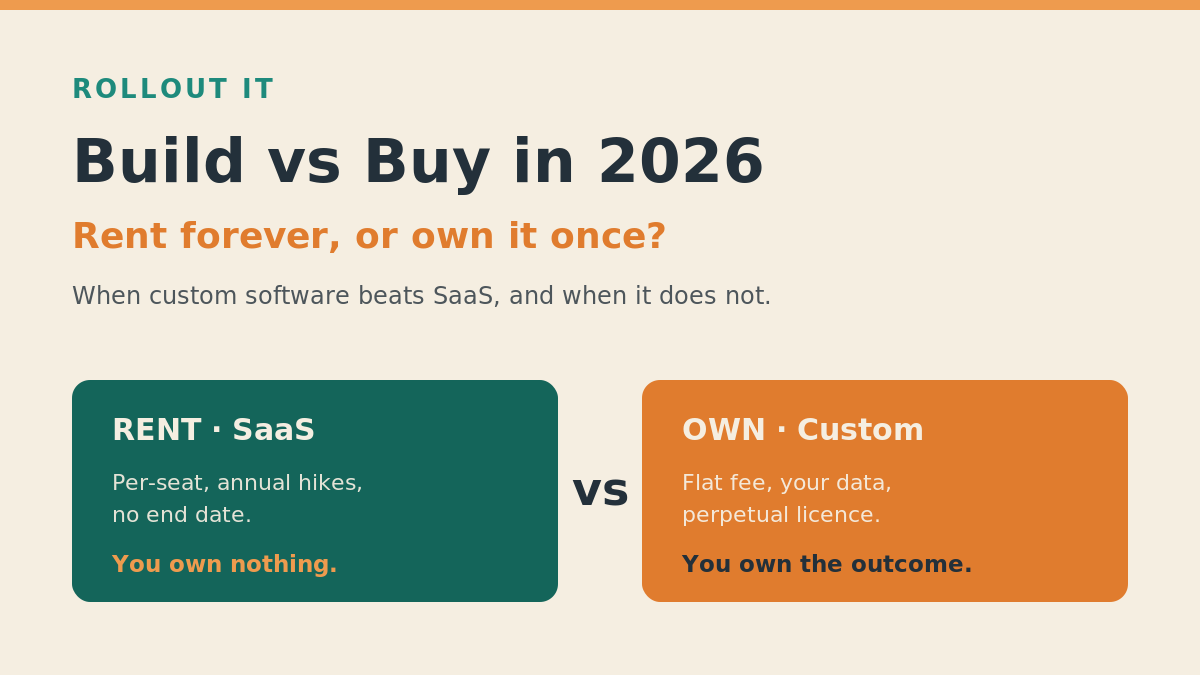
Build vs Buy in 2026: When Custom Software Beats SaaS
Last updated: July 29, 2026.
Build vs buy is the decision between subscribing to off-the-shelf SaaS and owning custom software built around your workflow. In 2026 the maths has shifted: AI-assisted delivery has cut build times and cost, while per-seat SaaS keeps compounding. For a specific class of tools, building (or co-funding a build) now beats renting.
This guide lays out what the decision really means today, the signals that point toward a custom build, the cases where you should keep the SaaS, and what it costs once you count five years instead of one.
What does “build vs buy” mean in 2026?
Build vs buy used to be a straight trade: write software yourself (slow, expensive, yours to maintain) or subscribe to SaaS (fast, cheap upfront, someone else’s problem). That framing assumed building was always hard and buying was always simple. Neither holds cleanly any more.
Two things changed. Agentic engineering, where senior engineers direct code-generation agents and stay accountable for the output, has compressed delivery timelines that used to run six months into six to eight weeks. And “buying” now means signing an open-ended, per-seat rental with annual price rises and no ownership of the result. So the honest question is no longer “build or buy?” It is “rent forever, or own it once?”
When does custom software beat SaaS?
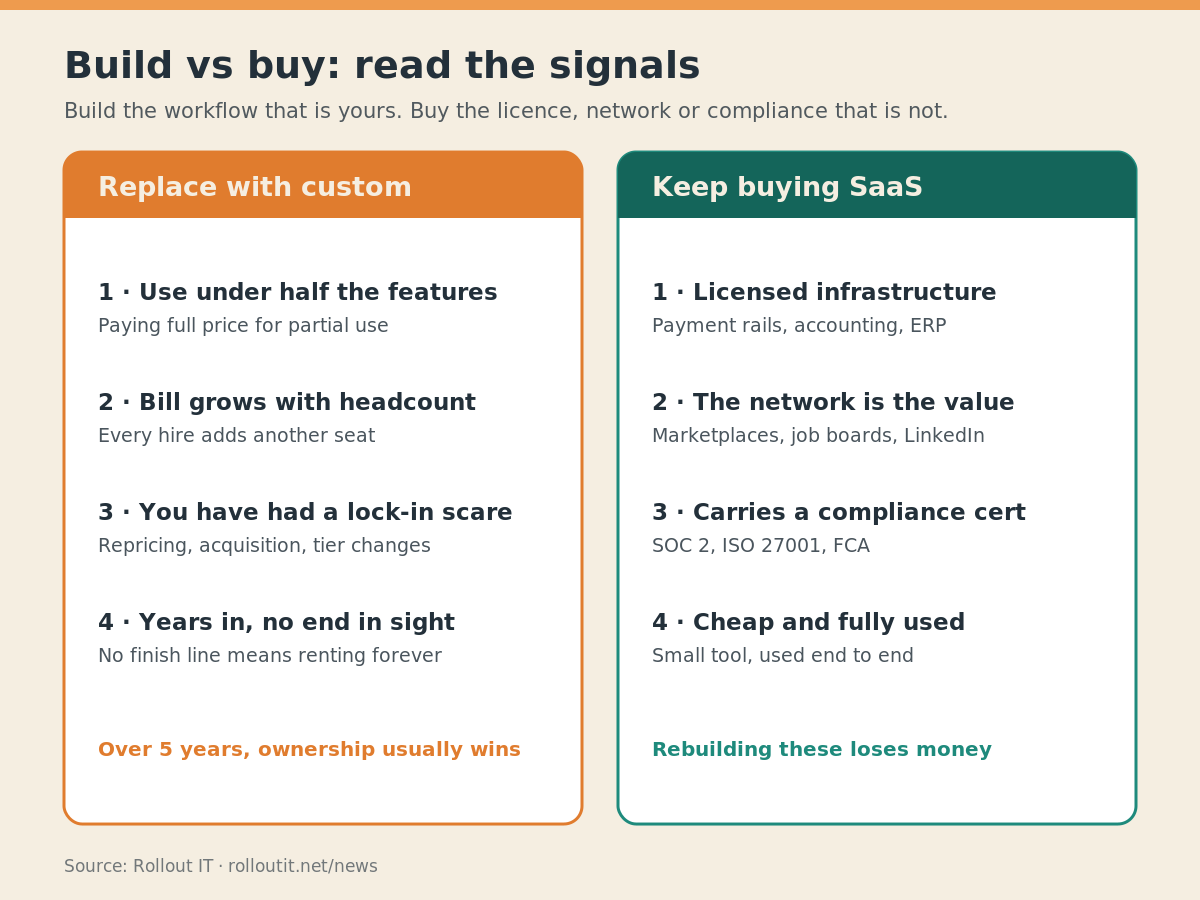
Custom software beats SaaS when you are paying a growing per-seat bill for a tool you only partly use, with no end date in sight. Four signals make the case concrete:
- You use less than half the features but pay for the whole product. Most teams run on a handful of core workflows while subsidising modules they never open. Industry data backs this up: Gartner estimates around a quarter of SaaS spend goes to unused entitlements, and Zylo’s 2025 SaaS Management Index found more than half of provisioned licences sit idle.
- The bill grows with headcount. Per-seat pricing means every hire raises the bill whether or not that person gets proportional value from the tool.
- You have had a lock-in scare. A vendor acquisition, a pricing restructure, or a feature you relied on moved to a higher tier: each is a reminder that you do not control the roadmap or the exit.
- You have been a customer for years with no finish line. If a subscription never ends, you are renting forever. Over five years that is often where a custom build would already have paid for itself.
We cover when replacing a SaaS tool with custom software pays off in more depth on our Unseated project, including the crossover maths.
When should you keep buying SaaS?
Building is not always the answer, and the fastest way to lose money is to rebuild something that should stay bought. Keep the SaaS when:
- It is licensed infrastructure. Payment rails (Stripe, GoCardless, Adyen) and accounting or ERP systems are not just software: they carry banking relationships, fraud models, and regulatory filing obligations that took years to certify.
- The vendor’s network is the value. Job boards, marketplaces, and platforms like LinkedIn hold the data and audience you are actually paying for. You cannot rebuild the network.
- It clears a compliance bar you would otherwise have to build. SOC 2, ISO 27001, or FCA certification represent a programme of work, not a feature.
- It is genuinely cheap and fully used. A small, low-cost tool your team uses end to end is doing its job. Leave it alone.
One page, one rule of thumb: build the software that encodes your competitive workflow, buy the software that runs on someone else’s licence, network, or compliance certification.
What does it actually cost to build vs buy?
The old objection to building was the upfront cost, and it was fair. A bespoke rebuild of, say, a field-service or job-management tool can run tens of thousands in senior engineering time, which few mid-sized companies want to absorb alone for software that is merely “good enough.”
Two shifts change the arithmetic. First, agentic delivery lowers the engineering hours, so the build itself is cheaper than it was in 2022. Second, co-funding spreads the remaining cost: several companies with the same core use case share one build and each pay a fraction, then a flat annual fee with no per-seat component. Set against a SaaS bill that rises every year and every hire, the five-year total cost of ownership frequently favours ownership, and the gap widens the longer you stay.
The key is to compare five-year totals, not month-one prices. A subscription looks cheap in isolation; projected across renewals, price hikes, and headcount growth, it is a very different number.
How fast can you build now?
Fast, but “fast” needs a definition. AI-assisted, senior-led delivery can take a rebuild that once needed six months down to roughly six to eight weeks. That is real, and it is what makes the per-company build cost low enough to reach crossover inside the first year.
What it is not is vibecoding: a prototype thrown together with no tests, no architecture, and no one accountable when it fails in production. The agent is a tool that accelerates senior engineers; it does not replace the engineering judgement, review, and ownership that keep software running. That distinction is the difference between an asset you own and a liability you inherited.
How Rollout IT approaches build vs buy
We build production software end to end, so our view is not theoretical. Our delivery work spans custom platforms such as Tickerbell, an algorithmic trading platform built from the ground up; DropIt, a Shopify reverse-auction plugin; Skillbandit, a soft-skills assessment job board; and Black Wolf, a full SaaS game-engine platform. The clearest build-vs-buy example is our custom B2B procurement platform: the client’s off-the-shelf web-shop flow forced every order through a slow, manual approval detour, so we replaced it with software built around their actual procurement workflow. Different domains, one pattern: software shaped around a specific workflow that off-the-shelf tools did not serve well.
That experience is also why we do not tell every client to build. When a SaaS is the right call, we say so. When it is not, we scope the real cost of a replacement and deliver it with senior engineers rather than a hand-off to juniors, through our custom software development practice and our AI-assisted development approach. The starting point is never a commitment to build: it is a scoping conversation about which tool you would replace if the economics made sense.
The takeaway for 2026: treat build vs buy as an ownership decision, run it on five-year numbers, and reserve custom software for the workflows that are genuinely yours.
Frequently asked questions
Is it cheaper to build or buy software?
Buying is cheaper in month one; building is often cheaper over five years for tools you use heavily and pay per seat for. The right comparison is total cost of ownership across renewals, price rises, and headcount growth, not the first invoice.
When should you build custom software instead of using SaaS?
When you use only part of a growing per-seat tool, have no realistic end date, and the workflow is core to how you compete. Keep buying when the tool is licensed infrastructure, a network you cannot replicate, or a compliance certification you would otherwise have to earn.
Has AI made building software cheaper than buying?
AI-assisted, senior-led delivery has lowered build times and cost significantly, which improves the case for building. It has not removed the need for real engineering: unreviewed, unaccountable “vibecoded” software is a risk, not a saving.
How long does a custom replacement take?
With agentic, senior-led delivery, a focused rebuild typically runs eight to fourteen weeks from first scoping conversation to go-live, with migration handled in parallel so you keep the old tool until the replacement is verified.
Sources: Rollout IT: Custom Development; Rollout IT: AI Development; Rollout IT: Tickerbell; Rollout IT: DropIt; Rollout IT: Skillbandit; Rollout IT: Black Wolf SaaS game engine; Rollout IT: Custom B2B procurement platform; Unseated: Build vs buy in 2026; Zylo 2025 SaaS Management Index; Vertice SaaS Inflation Index.