
Nearshoring to Central Europe: A 2026 Guide for NW-EU and US Tech Leaders
Nearshoring to Central Europe means building software with engineering teams in nearby, time-zone-aligned countries like Poland, Hungary, and Slovenia instead of distant offshore locations. For NW-EU and US tech leaders in 2026, it delivers 40 to 50 percent cost savings at comparable seniority, overlapping working hours, and EU data residency, without the friction that made classic offshore painful.
What is nearshore software development, and why Central Europe?
Nearshore software development means outsourcing engineering to a country close to your own, so working hours overlap and travel is short. Central Europe has become the default nearshore region for Western European and North American buyers because it combines deep technical talent, EU membership, and rates well below Western levels.
The economics back the trend. The nearshore segment is growing roughly 14 percent per year, faster than the broader European IT outsourcing market’s ~7.4 percent CAGR, which is projected to reach about $282 billion by 2030. That growth is not accidental: buyers are moving work toward regions where language, culture, and legal frameworks align with their own.
At Rollout IT, we see steady demand for nearshoring to Central Europe in our own search data, with buyers consistently searching for nearshore partners in the region. It is a pattern we live day to day as a Hungary-based partner serving NW-EU, US, Canada, and UK teams.
Nearshore vs offshore: what actually changes for delivery?
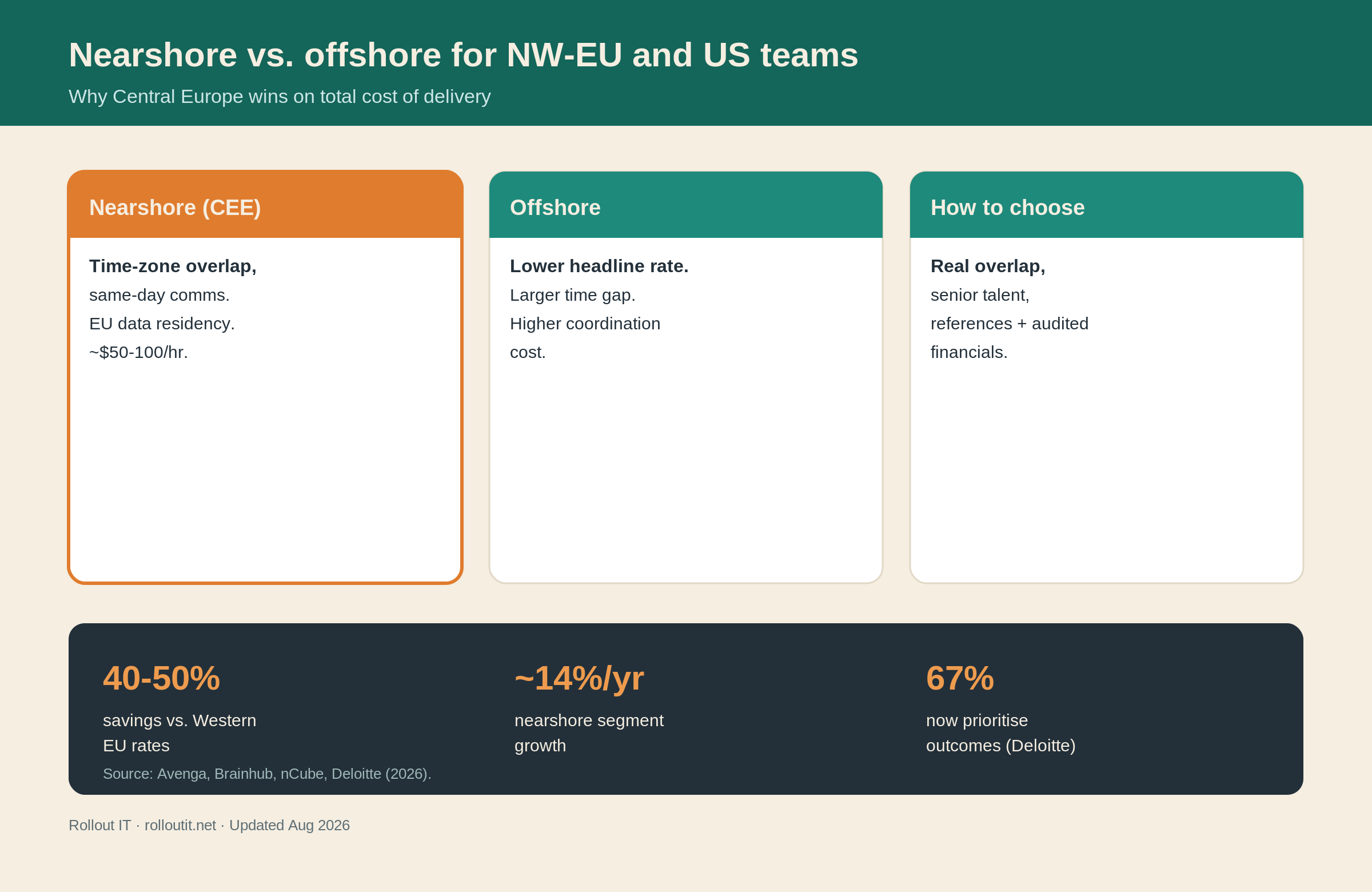
Nearshore and offshore both mean outsourcing, but the difference shows up in delivery: time-zone overlap, communication cadence, and legal alignment. Offshore can win on headline rate; nearshore wins on the total cost of coordination, which is where most distributed projects actually leak time and money.
The practical gap is the working day. A Central European team shares most of the afternoon with US East Coast teams and the full day with Western Europe, so questions get answered inside one business day instead of bouncing across a 10 to 12 hour gap. That single factor changes how fast you can ship.
| Dimension | Nearshore (Central Europe) | Offshore (distant regions) |
|---|---|---|
| Time-zone overlap with NW-EU | Full working day | 0 to 4 hours |
| Time-zone overlap with US East | ~4 to 6 afternoon hours | Minimal |
| Blended senior rate | ~$50 to $100/hr | Often lower headline rate |
| Cost saving vs Western Europe | ~40 to 50% at comparable seniority | Can be higher, but coordination cost rises |
| EU data residency / GDPR | In-region, EU-native | Cross-border transfer complexity |
| Communication cadence | Same-day answers | Next-day handoffs |
| Cultural / language fit | High (EN/DE common) | Variable |
How much can you save nearshoring to Central Europe in 2026?
You can expect roughly 40 to 50 percent cost savings at comparable seniority compared with Western European rates. Blended nearshore rates across Central Europe, including Poland, Hungary, and Slovenia, sit around $50 to $100 per hour depending on role and seniority.
But cost is no longer the headline reason buyers move. The primary driver has shifted from price to talent access. Deloitte reports that 67 percent of organisations now prioritise business outcomes over cost, and around 42 percent prioritise engineer quality over hourly rate. In other words, teams nearshore to get better engineers who ship the right thing, and the savings come along for the ride.
That reframes the buying decision. The question is no longer “who is cheapest” but “who gives me the strongest engineers in a working relationship I can actually manage.” For a fuller cost breakdown by engagement model, see our staff augmentation page.
Why do EU data residency and compliance favour nearshoring?
EU data residency favours nearshoring because Central European countries are EU member states, so your data stays inside the same legal framework you already operate under. For GDPR-bound and regulated buyers, that removes the cross-border transfer complexity that offshore locations introduce.
Keeping development inside the EU means no third-country transfer assessments, no standard contractual clause gymnastics, and a supplier that already lives under GDPR by default. When your auditors ask where the code and the data sit, “an EU member state” is a clean answer.
This matters most for finance, health, public sector, and any product handling personal data of EU citizens. It is also a reason many NW-EU buyers pair nearshore delivery with EU market plans; our EU market expansion work sits alongside the same GDPR-ready posture.
How do you choose a nearshore partner? (time zone, talent, track record)
Choose a nearshore partner by testing three things: real time-zone overlap, genuine senior talent, and a verifiable track record. If a vendor scores well on all three, the hourly rate becomes a detail rather than the decision. Here is the checklist we use, written from the delivery side of the table.
- Time-zone overlap: Confirm the actual working hours your team will share, not just the country. Ask how many overlap hours you get with your core team and how urgent questions are handled.
- Seniority you can verify: Ask to meet the actual engineers, not an account manager. Check for real senior depth, since talent quality now outranks rate for most buyers.
- Track record and references: Look for years in operation, project count, and independent reviews on platforms like Clutch. Ask for references in your industry.
- Legal and financial reliability: Check the legal entity, licensing, and financial stability. A workforce-leasing licence and audited financials signal a partner that will still be there next year.
- EU data residency: Confirm where data and code live, and that GDPR processes are native, not bolted on.
- Communication culture: Proactive, same-day communication is the difference between nearshore working and just being cheaper. Test it during the sales process.
Why NW-EU and US teams nearshore with Rollout (first-hand)
NW-EU and US teams nearshore with Rollout IT because we operate as a true extension of your in-house team, not a distant vendor. We are a Hungary-based nearshore partner with 10+ years in business, 50+ delivered projects, and 30+ experts, serving NW-EU, US, Canada, and UK clients from a Central European base.
The reliability signals matter to procurement, so we put them on the table early. Our legal entity, Runios IT Ltd., holds a Hungarian workforce-leasing licence and files audited financials, so a due-diligence team can verify that we are a low-risk, EU-native partner. That combination, senior engineers plus a solid legal and financial footing, is exactly what the checklist above is built to find.
Where teams need more than engineers, we also help with EU go-to-market through our EU market expansion offer, and we staff dedicated engineers through staff augmentation. If you are still comparing providers, our guide on how to choose a staff augmentation company walks through the selection process in more depth.
Frequently asked questions
What does nearshoring to Central Europe mean?
It means building software with engineering teams in nearby Central European countries such as Poland, Hungary, and Slovenia, where working hours overlap with Western Europe and part of the US day, instead of using distant offshore locations.
How much cheaper is nearshore software development in Europe?
You can typically save 40 to 50 percent at comparable seniority versus Western European rates. Blended Central European rates sit around $50 to $100 per hour depending on role and seniority.
Is nearshore better than offshore?
It depends on your priorities, but for most NW-EU and US teams nearshore wins on total cost of delivery. Offshore may have a lower headline rate, while nearshore reduces coordination cost through time-zone overlap, same-day communication, and legal alignment.
Does nearshoring to Central Europe help with GDPR and data residency?
Yes. Central European countries are EU member states, so your data stays inside the EU legal framework. This removes third-country transfer complexity and suits GDPR-bound and regulated buyers.
Why is talent access, not cost, now the main driver?
Deloitte reports that 67 percent of organisations now prioritise business outcomes over cost, and about 42 percent prioritise engineer quality over hourly rate. Buyers nearshore to reach strong engineers, and the cost savings follow.
How do I choose the right nearshore partner?
Test three things: real time-zone overlap, verifiable senior talent, and a track record backed by references, licensing, and audited financials. Confirm EU data residency and a proactive communication culture before you sign.